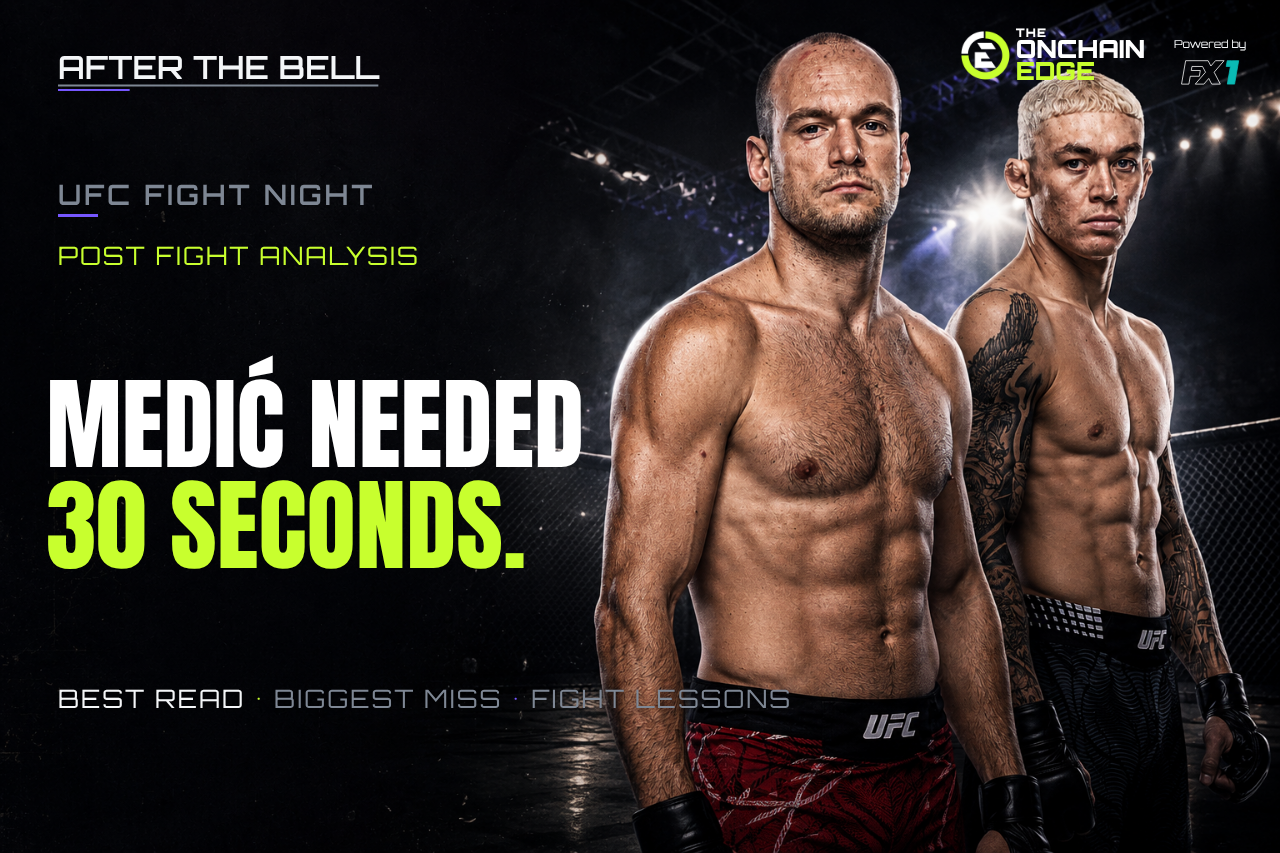
Uroš Medić had waited his entire career for this moment.
The UFC had arrived in Serbia. He was standing in the main event, carrying the crowd with him, opposite a veteran expected to test whether his early violence could hold up against experience and durability.
Thirty seconds later, Daniel Rodriguez was finished.
It was the perfect ending to a card that had barely paused for breath. Ten of the 14 fights ended in the opening round, while only two reached the judges. Across a possible 220 minutes of cage time, the event used roughly 75.
That statistic captures the madness of the night, but Medić provided its real meaning.
This was his arena, his crowd and his moment. He did not waste any of it.
Medić refused to let the fight develop
The main-event read in Fight Lab came down to time.
Rodriguez needed it. Medić did not.
The longer the fight lasted, the more useful Rodriguez’s toughness, volume and experience were likely to become. He needed to survive the opening exchanges, settle the pace and make Medić work beyond the explosive early phase where he has been most dangerous.
Medić gave him no such opportunity.
Rodriguez opened with a low kick, but Medić quickly burst forward with a sharp combination that sent him backwards and into survival mode. The follow-up arrived immediately. Before the fight had properly taken shape, the referee was already stepping in.
The prediction of Medić by first-round KO/TKO landed exactly, but even that did not fully capture how one-sided the finish would be.
Medić’s deeper-round questions remain because nobody has been able to force him into those rounds. That is still relevant against the division’s best. It just feels far less urgent after four consecutive first-round finishes.
He called for Leon Edwards again afterwards. Whether that particular fight is next matters less than the level of opponent he receives. Medić now deserves somebody capable of surviving the opening attack and forcing him into less familiar territory.
Belgrade did not answer every question about him.
It made finding somebody able to ask them much more interesting.
Stirling’s career just accelerated
Navajo Stirling was expected to be quicker and busier than Jan Błachowicz.
The Fight Lab picked him to win a decision, largely because Błachowicz had remained difficult to finish even while his results declined.
Stirling had other plans.
Błachowicz caught him cleanly early and briefly showed why such a large step up in experience can be dangerous. Stirling recovered, reset and then turned the fight completely. He dropped the former champion before following him to the canvas and unloading with punches and elbows.
The stoppage came inside the opening round.
The winner prediction was right. The method was not remotely close.
That may be the more important takeaway.
Stirling had already shown patience, range control and the ability to bank rounds. Against Błachowicz, he showed he could take a clean shot from the most accomplished opponent of his career, remain composed and then finish him when the chance appeared.
He is no longer simply an unbeaten prospect who should be moved carefully. He has stopped a former champion and will now be judged against contenders rather than developmental opposition.
For Błachowicz, the picture is harder to ignore. He is 43, has not won since 2022 and has now gone five fights without victory.
Retirement remains his decision, but this did not look like another narrow loss against an elite opponent. He was hurt and finished by a younger fighter making the biggest jump of his career.
Stirling looked ready for what comes next.
Błachowicz looked closer to the end than the beginning.
Musayev was the wrong prediction and the right underdog
Ľudovít Klein was the Fight Lab prediction.
Tofiq Musayev was the Betting Slate selection.
That needs explaining, but it is not a contradiction.
Klein looked like the more likely winner before the fight because of his consistent UFC form, cleaner round-winning style and ability to mix his striking with wrestling. Musayev was still considered a genuine live underdog, and the price available on him was too large for the matchup.
One question asks who is most likely to win. The other asks whether the odds properly reflect each fighter’s chance.
In Belgrade, the prediction was wrong and the value angle was right.
Musayev looked sharper from the start. He attacked the legs and body, pushed Klein backwards and never allowed him to establish a comfortable rhythm. Klein’s attempts to wrestle did little to change the fight, while Musayev continued to build pressure before forcing the stoppage in Round 2.
The analytical mistake was placing too much weight on Klein’s recent UFC record and not enough on Musayev’s wider career.
Musayev had competed against experienced opposition, won a RIZIN Grand Prix and built his reputation around real finishing power. His short UFC résumé made him look less proven than he actually was.
The Fight Lab call missed.
The view that Musayev was being underestimated did not.
Rakić and Tybura showed the other side of the same idea
Aleksandar Rakić versus Marcin Tybura produced the reverse outcome.
Rakić was the Fight Lab prediction, with a decision considered the most likely result. Tybura was later backed as an underdog because the market appeared to give too little weight to his size, heavyweight experience and potential grappling route.
This time, the original prediction held and the value bet lost.
Again, there is no contradiction.
Tybura had a plausible path to victory if he could close distance, force repeated clinches and make Rakić work underneath him. He simply could not impose it.
Rakić was quicker, landed the cleaner strikes and controlled the range well enough to keep the fight where he wanted it. Tybura remained competitive, but his takedown attempts never developed into meaningful control. All three judges scored the contest 30-27.
The Rakić-by-decision prediction landed exactly.
It was a solid heavyweight debut rather than a transformation. Rakić looked like a larger version of the fighter already familiar at light heavyweight: athletic, controlled and difficult to hit cleanly, but occasionally content to protect a lead rather than press for more.
That can take him a fair distance at heavyweight.
The next test should tell us much more.
Oliveira looked ready immediately
Michael Oliveira arrived with plenty of hype and needed less than two minutes to justify it.
Oban Elliott was expected to offer the more awkward route through his wrestling, but Oliveira never allowed the fight to reach that stage. A crisp jab dropped Elliott, who then struggled to recover. Oliveira stayed balanced, dealt with the desperate takedown attempt and finished the fight with follow-up strikes.
The Fight Lab predicted Oliveira by KO/TKO in Round 2.
The method was right. The timing was cautious.
What stood out was not just the power. Oliveira stayed composed once Elliott was hurt and finished without throwing himself out of position.
His wrestling defence still needs a proper examination, but the UFC debut could hardly have gone better.
The hype is no longer based only on what he did before arriving.
Rębecki delivered exactly what was expected
Mateusz Rębecki was one of the strongest reads on the card.
Kyle Prepolec was tough enough to survive the first wave, but he could not stop Rębecki from taking control. The Pole secured the takedown and spent most of the opening round unloading punches, elbows and hammerfists from the top.
The stoppage came late in Round 1.
The prediction was Rębecki by second-round KO/TKO, so the finish arrived earlier and through more ground-and-pound than expected. The central read still held. Prepolec could not match the pressure, physicality or damage once Rębecki took over.
It was not subtle.
It did not need to be.
What the Fight Lab got right
Seven featured predictions were published before the event.
Five winners were correct:
- Uroš Medić
- Navajo Stirling
- Aleksandar Rakić
- Mateusz Rębecki
- Michael Oliveira
The misses were Klein over Musayev and Mark Vologdin over Borislav Nikolić.
That produced a 5-2 winner record and 71.4% accuracy.
Four winner-and-method calls landed:
- Medić by KO/TKO
- Rakić by decision
- Rębecki by KO/TKO
- Oliveira by KO/TKO
The main-event read was the strongest of the night. Rodriguez needed time and Medić gave him none.
The biggest miss was Musayev, whose wider résumé deserved more weight than his limited UFC record received.
Stirling sat somewhere between the two. The winner was right, but the forecast badly underestimated how quickly he could finish a former champion.
Final word
UFC Belgrade will be remembered for its pace.
Ten first-round finishes. Twelve stoppages. Barely 75 minutes of fighting across a 14-bout card.
But the fighters mattered more than the numbers.
Medić delivered a sensational hometown knockout and left looking ready for a serious step forward. Stirling accelerated his rise while raising difficult questions about Błachowicz’s future. Musayev proved he was much more dangerous than his UFC record suggested. Oliveira justified the excitement around him, and Rakić made a controlled start to life at heavyweight.
The first UFC event in Serbia needed a moment that would last longer than the card itself.
Medić provided it in 30 seconds.


Leave a Reply