Salahdine Parnasse did not ease his way into the UFC.
He kicked the door off its hinges.
Dan Hooker came into Paris with more than a decade of UFC experience, a significant height and reach advantage and a career spent fighting some of the best lightweights in the world. None of it had time to become particularly relevant.
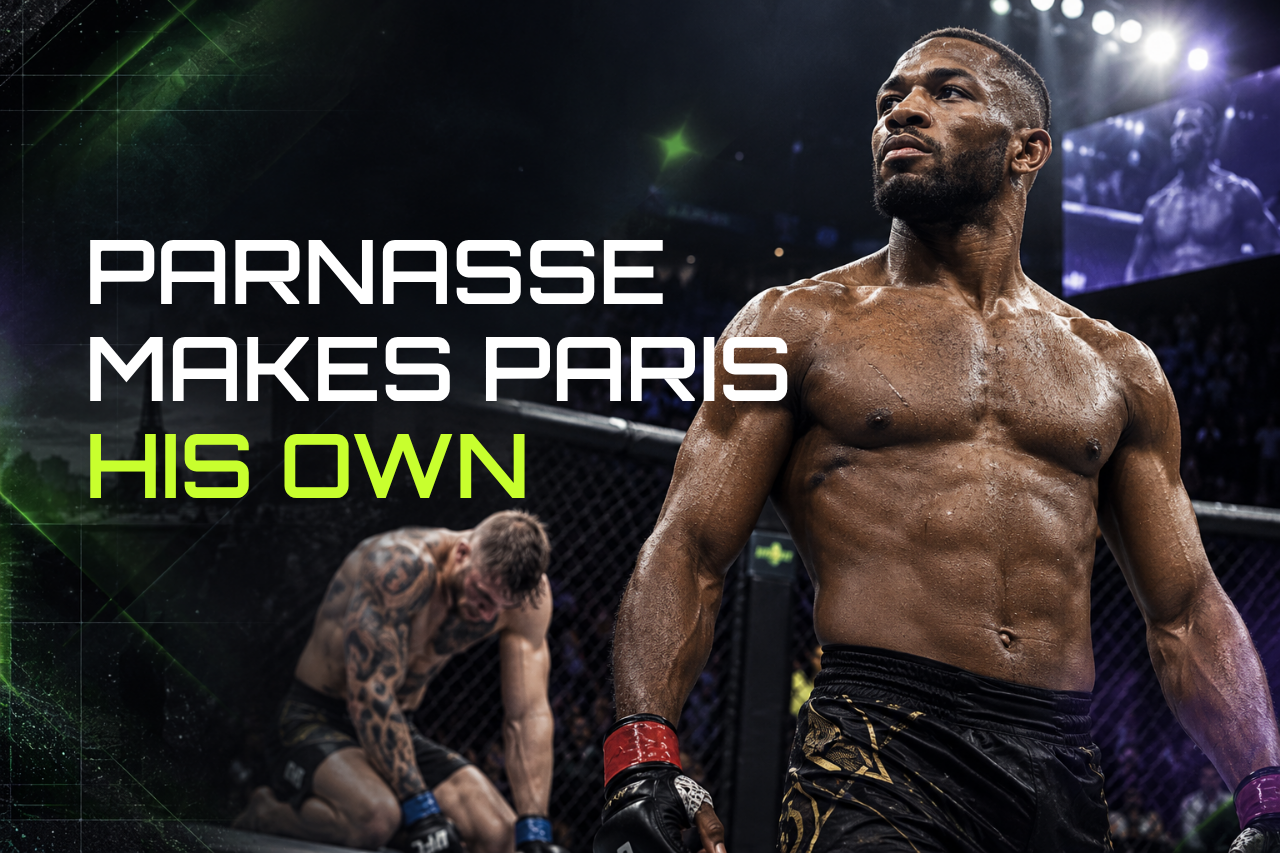
Parnasse spent the opening exchanges assessing the distance, attacking the legs and showing Hooker enough different looks to keep him reacting. Then came the shot that changed everything. A brutal body kick folded Hooker, Parnasse immediately recognised what he had done and the follow-up attack brought the stoppage midway through the opening round.
The pre-fight read had Parnasse winning by KO/TKO, although the TOE Model was much more cautious on the winner at only 53.4%. Even the more bullish interpretation underestimated just how quickly he would look at home.
Paris was supposed to tell us whether one of Europe’s best fighters outside the UFC could immediately translate that success to the Octagon.
The answer arrived quickly.
Parnasse Looked Nothing Like a Debutant
There was no nervous opening five minutes. No unnecessary attempt to prove himself. No moment where the occasion seemed bigger than the fighter.
Parnasse simply started building reactions.
That was the most impressive part of the finish. Hooker did not get caught because Parnasse threw one miraculous body kick from nowhere. The low attacks and feints were already making him process threats downstairs. Parnasse edged into range, showed speed with his hands and then punished the opening when Hooker gave it to him.
The UFC lightweight division will provide much harder nights than this one eventually, but there is little value now in treating Parnasse like a normal newcomer who needs several developmental fights.
Hooker was the test.
Parnasse demolished it.
The bigger question has already changed from whether he belongs to how quickly the UFC is prepared to move him.
Axel Sola Found an Even Faster Answer
Fares Ziam against Axel Sola looked like it might become one of the more technical fights on the card.
It lasted 100 seconds.
Ziam began doing the sort of work expected of him, operating at range and looking to establish his measured game. Sola then changed the fight with one beautifully set-up left hand.
He dipped his level as he came forward, forcing Ziam to react to the possibility of a different attack, then fired the left hook into the opening. Ziam was out immediately. There was no need for another strike.
This was one place where the pre-fight analysis had deliberately moved away from the model. The TOE number strongly favoured Ziam, while Fred’s pick went to Sola because his activity and physicality looked capable of disrupting Ziam’s preferred pace.
The winner call held up. The expected decision certainly did not.
And the knockout told us something more interesting than a three-round pressure win might have.
Sola is developing genuine variety.
The war with Mason Jones showed he could operate in chaos. The submission of Ismael Bonfim showed his grappling threat. Now he has switched off an experienced lightweight with one clean counter.
That makes him substantially harder to prepare for.
Donchenko Showed More Than Another Knockout Would Have
Daniil Donchenko did not leave Paris with another highlight-reel finish.
That may have been better for him.
Punahele Soriano represented a different problem from Donchenko’s earlier UFC opposition. He could punch, wrestle and force the younger man to spend energy somewhere other than throwing combinations.
Donchenko hurt Soriano early and spent much of the fight producing the cleaner work. He attacked different levels, managed his output and resisted the temptation to empty himself hunting a finish that was not always there. Soriano eventually found more wrestling success late, but Donchenko had already banked enough damage and control of the fight to take a clear unanimous decision, 30-27, 30-27 and 29-28.
The pre-fight call had Donchenko winning but went with decision rather than the model’s preferred KO/TKO.
The important part was not getting the method right. It was why the fight reached the cards.
Soriano made Donchenko solve a more complicated problem, and Donchenko did not respond by becoming reckless. The power is obvious. Paris showed a fighter increasingly capable of deciding when he actually needs to use it.
At 25, that development is considerably more interesting than another two-minute knockout.
Page Keeps Winning Michael Page Fights
Michael Page against Nursulton Ruziboev was something completely different.
Ruziboev found an early takedown and briefly threatened to make the fight uncomfortable. Page returned to his feet and from there the contest became extremely familiar.
Lots of space. Lots of waiting. Brief Page entries. Very few prolonged exchanges.
The Paris crowd hated large portions of it.
Page did not appear particularly bothered.
He did enough to win all three scorecards 29-28 and extend his winning run, once again demonstrating how difficult it is to make him participate in a conventional fight.
Page by decision had been the straightforward pre-fight read because there was little reason to expect him to suddenly abandon the style that keeps working for him.
Ruziboev’s early finishing threat was real, especially if he could get Page into grappling sequences. Once those opportunities disappeared, so did much of his route to controlling the fight.
There is now a strange divide around Page. Competitively, he remains extremely effective. As entertainment, some of these performances are becoming increasingly difficult to love.
Those two things can both be true.
Lima Won the Minutes Charriere Couldn’t
Morgan Charriere had the Paris crowd and the heavier-looking individual attacks.
Felipe Lima had more of the fight.
Charriere advanced, but Lima refused to let that pressure become control. He struck effectively around the movement, escaped the clinch without being pinned there for long periods and consistently found ways to score before resetting.
The judges gave Lima the fight 30-27, 30-27 and 29-28.
Lima by decision was another of the pre-fight calls built around exactly that dynamic. Charriere could have the louder moments, but Lima seemed more likely to own everything between them.
That is essentially what happened.
There was nothing spectacular about the performance, but beating a strong, dangerous featherweight in his home arena without allowing the occasion to drag you into his kind of fight says plenty.
Lima looks ready for a meaningful step up.
Keita Finally Delivered the Performance People Expected
Losene Keita’s first UFC appearance had shown flashes without quite producing the statement his reputation promised.
Muhammad Naimov got the full version.
Keita hurt him almost immediately, later dropped him with a jab and then ended the fight with a clean right hook at 2:54 of the first round.
The pre-fight pick had moved from the model’s Keita decision projection to KO/TKO because Naimov looked vulnerable when exchanges became quick and messy.
Keita did not even need much mess.
The speed difference was obvious, the power translated and once Naimov was hurt, Keita never allowed him back into the contest.
That looked much more like the fighter who arrived from Oktagon with so much attention behind him.
Bukauskas Changed the Fight When Sy Couldn’t
Oumar Sy against Modestas Bukauskas may have delivered the most useful lesson of the prelims.
For a round, Sy looked dominant.
He got on top, imposed his physicality and made Bukauskas spend long stretches defending. It was easy to see why both the model and the final pre-fight pick had favoured Sy.
Then his energy disappeared.
Bukauskas noticed.
Instead of becoming discouraged by the first round, he started pushing the pace as Sy slowed. The positions became harder for Sy to maintain, the pressure began going in the opposite direction and Bukauskas eventually overwhelmed him for the second-round stoppage at 3:57.
It was a veteran win.
Bukauskas survived the part of the fight where Sy was strongest and was still capable of increasing his own output when the Frenchman no longer could.
At light heavyweight, that can erase a lot of technical advantages very quickly.
Final Word
Paris was built around Salahdine Parnasse, and for once the promotional story played out almost perfectly.
He arrived with an enormous reputation and somehow left looking more dangerous.
But the card produced plenty underneath him.
Axel Sola added one-shot knockout power to an increasingly complicated skill set. Daniil Donchenko showed patience that may ultimately matter more than another finish. Felipe Lima quietly dismantled the advantages of a dangerous home fighter. Losene Keita finally showed UFC fans the explosiveness that made his arrival interesting in the first place.
Even the less attractive Page-Ruziboev fight told us something. Michael Page is still extraordinarily good at forcing opponents to fight on his terms, even when almost everyone watching wishes those terms were different.
The pre-fight analysis gave us a framework for what might happen. Saturday gave us the part that actually counts.
And the clearest takeaway belongs to the main event.
Salahdine Parnasse did not come to the UFC to find out whether he belongs.
He already looks ready to find out how far he can go.