
Paris has quickly become one of the UFC’s most reliable European stops. The crowd is loud, the French roster keeps getting deeper and this card has been built around local talent from top to bottom. All 28 fighters made weight on Friday, so the full 14-fight card reaches Saturday intact.
At the top sits one of the strangest UFC debuts in recent memory.
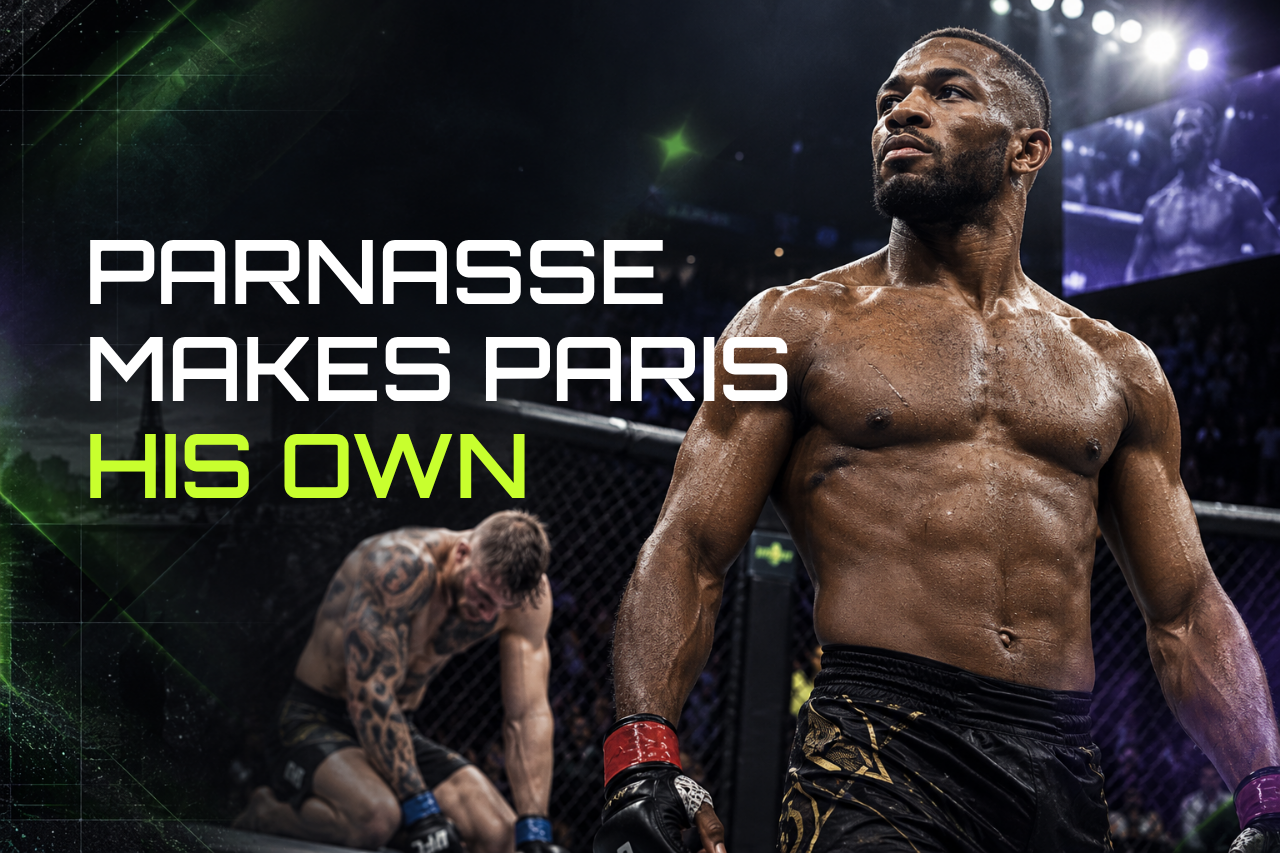
Salahdine Parnasse is not arriving like a normal newcomer. He is 28, 23-2, a former KSW featherweight and lightweight champion and has already competed in 14 professional title fights. He went 14-2 during a decade with KSW, is unbeaten at lightweight and has finished his last nine victories. Seven of those have come consecutively by KO or TKO. The UFC has skipped the introduction completely and handed him Dan Hooker for five rounds in his home city.
The market has treated that transition as almost a formality, with Parnasse trading around -600 during fight week. The TOE Model is nowhere near as certain. It gives Parnasse only a 53.4% chance of beating Hooker, the narrowest winner edge among the five fights featured here. If Parnasse wins, KO/TKO is the leading method at 56.9%.
That disagreement is one of the reasons this is the right fight to lead Fight Lab.
There are cleaner model calls elsewhere. Mario Pinto sits at 84.0%, Losene Keita at 82.8% and Daniil Donchenko at 80.0%. But Fight Lab is not supposed to be fourteen percentages stretched into fourteen essays. The interesting fights are the ones where styles, form and context give us something worth arguing about.
This week the deeper look goes to Hooker vs Parnasse, Fares Ziam vs Axel Sola, Michael Page vs Nursulton Ruziboev, Daniil Donchenko vs Punahele Soriano and Morgan Charriere vs Felipe Lima.
The TOE Model remains one part of the evidence. Fred’s Pick at the end of each section is the final editorial call.
If you just want the answer on every fight without the long-form breakdown, the full card is in Picks.
Dan Hooker vs Salahdine Parnasse
The easy version of this fight is that Parnasse is younger, faster, fresher and catching Dan Hooker at exactly the right time.
There is plenty of evidence for it.

Hooker is 36 and has 38 professional fights behind him. His UFC numbers tell the story of a fighter who has rarely built his career around avoiding damage. He lands 4.82 significant strikes per minute and absorbs 4.94, with only 49% significant-strike defence. After the excellent split-decision win over Mateusz Gamrot in 2024, he was submitted by Arman Tsarukyan and then stopped by Benoît Saint Denis in January.
Parnasse could hardly arrive from a more different trajectory.
He is 7-0 at lightweight, has eight knockout wins and seven submissions across his career and has spent years fighting championship rounds rather than working his way through regional prelims. Calling him a prospect almost undersells what is happening here. He is an established elite fighter from outside the UFC being asked whether that level transfers immediately against a hardened UFC contender.
The answer may well be yes.
It is the certainty around it that feels uncomfortable.
Hooker owns a meaningful physical advantage. He is six feet tall with a 75-inch reach. Parnasse stands 5ft 10in with a reach around 71.5 inches. Hooker cannot afford to waste that by meeting Parnasse in the pocket simply because those are the fights in which he has made his name.
His best version of this matchup starts long.
Jab. Front kick. Straight right. Knees when Parnasse tries to cross the gap. Make the Frenchman solve the distance before allowing him to show how many other weapons he has.
Hooker has fought Dustin Poirier, Islam Makhachev, Arnold Allen, Jalin Turner, Gamrot, Tsarukyan and Saint Denis. There is very little Parnasse can show him conceptually that Hooker has never seen before.
What Parnasse can do is make Hooker process several threats at once.
The southpaw striking is sharp enough to win exchanges on its own, but Parnasse also carries legitimate submission ability and has spent most of his career looking comfortable when fights move between phases. He can kick, box, clinch, wrestle and threaten the neck without needing one part of the game to carry everything else.
That versatility attacks one of Hooker’s biggest problems.
Hooker is dangerous once he understands the fight in front of him. Give him a predictable striking rhythm and he starts building reads. Give him clear wrestling entries and his career takedown defence of 77% shows he is capable of making those attempts expensive.
Parnasse has the tools to stop the picture becoming that clean.
A kick can become a boxing entry. The boxing can push Hooker towards the fence. The fence gives Parnasse access to the clinch. Hooker starts thinking about the level change and suddenly the next clean left hand becomes easier to find.
Parnasse does not need to wrestle Hooker like Tsarukyan did. He only needs the grappling threat to affect the striking.
There is also a less complicated problem.
Hooker gets hit.
His toughness has produced some extraordinary fights, but toughness only helps after the opponent has already landed. Parnasse is coming into the UFC with seven consecutive KO/TKO victories, while Hooker has just been finished twice in succession. If Parnasse can repeatedly force defensive reactions and attack Hooker while he is resetting, there is every chance the damage begins accumulating quickly.
Hooker’s route becomes more interesting if the first ten minutes remain competitive.
Parnasse has championship experience, so this is not a question of whether he understands long fights. It is a question of what a five-round UFC main event against Dan Hooker feels like when the expected early dominance does not arrive.
Hooker needs to make Parnasse cross distance again and again. Force him to reset after failed entries. Make the clinches physical. Attack the body. Make every attempt to close the gap cost something.
If this reaches the fourth round with Hooker still landing at range and refusing to be backed into prolonged defensive sequences, the fight could look very different from the pre-fight odds.
That is why the TOE Model’s 53.4% is interesting even if it ultimately feels too conservative. It is refusing to treat Parnasse’s UFC translation as proven simply because everything before the UFC looked excellent.
The final read still lands firmly on the Frenchman.
Parnasse is younger, quicker and has more ways to interrupt Hooker’s preferred rhythm. Hooker should have success if he uses his length properly, but asking him to avoid sustained pressure and damaging exchanges for 25 minutes is difficult when his recent fights have shown exactly how costly those moments can become.
A finish does not have to come immediately. Parnasse can win the early minutes, force Hooker to defend multiple threats and let the damage build until toughness stops being enough.
Fred’s Pick: Salahdine Parnasse by KO/TKO
Fares Ziam vs Axel Sola
This is the clearest disagreement between Fred and the TOE Model among the featured fights.
The model gives Fares Ziam a sizeable 69.1% win probability. If he wins, decision is its leading method at 53.6%. That is not a marginal lean. The numbers see Ziam as clearly the more likely winner.
The case is easy to understand.

Ziam has been in the UFC since 2019 and spent most of the past four years becoming increasingly difficult to beat. His June defeat to Tom Nolan ended a six-fight winning streak that included Matt Frevola, Mike Davis, Claudio Puelles and Nazim Sadykhov.
His statistical profile is extremely tidy. Ziam lands only 2.68 significant strikes per minute, but absorbs just 1.58. His significant-strike defence sits at 64%, and he mixes in nearly two takedowns per 15 minutes. He does not need huge offensive volume because he is usually good at limiting what comes back.
At his best, very little happens accidentally against Ziam.
He likes control. Long range, measured kickboxing, clinch positions, cage pressure when the opportunity appears. He is comfortable winning minutes without needing to turn every exchange into a major event.
The Nolan fight exposed the risk.
Once Ziam could not consistently impose himself physically, too much of his offence disappeared with it. Nolan matched the size, prevented Ziam from turning difficult striking exchanges into reliable clinch control and made him operate for long stretches in a fight where his relatively low output became a liability.
Axel Sola can ask some of the same questions.
Sola is 12-1-1, a former Ares FC champion and already has three UFC fights behind him. He stopped Rhys McKee, lost a violent decision to Mason Jones and returned in July to submit Ismael Bonfim with a D’Arce choke in the opening round. He currently lands 4.50 significant strikes per minute, considerably more than Ziam, although the 4.53 he absorbs tells you that those exchanges are not one-way traffic.
That willingness to exchange is both the attraction and the danger.
Mason Jones showed how ugly the fight can become for Sola when someone matches his pace, physicality and willingness to stay directly in front of him. Ziam is not naturally that fighter.
He is more selective.
That becomes the central question. Can Ziam make Sola fight at his speed, or can Sola deny him the quiet minutes he normally uses to build rounds?
Ziam’s route is cleaner technically.
Use the length. Kick the body. Force Sola to reach. Make him overcommit on entries and punish those moments with straight shots, knees and clinch work. Sola can be hit, and Ziam is good enough defensively to make an aggressive opponent become frustrated by misses.
Sola’s route is to prevent the fight from ever becoming comfortable enough for that.
Press forward. Keep Ziam resetting. Make him work through transitions rather than allowing him to settle at long range. Contest the clinch instead of accepting it. Force him to produce enough offence that he cannot win rounds through isolated clean moments and defensive control.
There is genuine disagreement elsewhere too. MMA Mania’s main-card breakdown sides with Ziam by decision, while its wider betting analysis prefers Sola. Covers also backs Sola, specifically pointing towards his output and finishing upside.
That split makes sense.
Ziam is probably the cleaner fighter in a vacuum.
This is not a fight in a vacuum.
Sola’s combination of activity, physicality and willingness to keep changing the exchange attacks an area that looked uncomfortable for Ziam only three months ago. Ziam can absolutely win this by making Sola chase him around the outside for three rounds. The concern is whether he produces enough while doing it.
The TOE Model sees the veteran experience, defensive numbers and broader UFC sample and lands heavily on Ziam.
The matchup pushes Fred the other way.
Fred’s Pick: Axel Sola by decision
Michael Page vs Nursulton Ruziboev
Michael Page fights can be maddening.
That does not make what he does any less effective.

Page is now 39 and 4-1 in the UFC. He has beaten Kevin Holland, Shara Magomedov, Jared Cannonier and Sam Patterson, with all four victories going to the scorecards. His only UFC defeat came against Ian Machado Garry.
The highlight-reel knockouts that built Page’s reputation have largely been replaced by something much more controlled: distance, feints, sudden bursts of offence and long periods where the opponent simply cannot make him fight at the tempo they want.
Ruziboev looks like someone built specifically to reject that sort of fight.
He is 6ft 5in, 37-9-2 and has 34 finishes among those 37 victories. Twenty-one have come by submission. Twenty-six have come in the first round.
After dropping to welterweight and losing to Joaquin Buckley, Ruziboev returned to middleweight and rebuilt momentum. Most recently he submitted Andrey Pulyaev in the first round, pushing his current run to 13 wins in his last 14.
There is almost no overlap in how these two want the fight to feel.
Page wants space.
Ruziboev wants something to happen.
The obvious threat is grappling. Ian Machado Garry provided the only successful UFC blueprint against Page so far by taking away enough open-space striking and forcing him to deal with wrestling and control.
Ruziboev owns far more submission victories than Garry ever will, but the comparison only goes so far. Having 21 submissions does not automatically mean he can consistently put Michael Page on the floor.
He still has to reach him first.
That has been the central problem facing almost everyone since Page arrived in the UFC.
Page stands 6ft 3in with a 79-inch reach. Ruziboev is taller at 6ft 5in, but his reach is actually shorter at 76 inches. The Uzbek does not face the cartoonish physical disadvantage some Page opponents do, but he is still trying to close distance on one of the most elusive fighters in the division.
The first round is likely to tell us plenty.
Ruziboev has 26 first-round finishes because he is at his best before opponents have properly settled. He is dangerous when he can force a reaction, explode into the opening and turn the first meaningful connection into something much bigger.
Page is one of the worst opponents in MMA to chase through open space.
He is perfectly willing to spend a minute doing almost nothing if that minute keeps the opponent outside his preferred attack. Then he suddenly closes the distance himself, scores and disappears again.
The Patterson fight annoyed people for exactly that reason.
Page did not care.
That is useful evidence here.
Ruziboev needs to resist the temptation to have an extended striking duel with a fighter who has spent his entire career making conventional kickboxers look awkward. His best path involves cutting the cage rather than following Page, attacking kicks, forcing contact and making the clinch mean something when it arrives.
Even unsuccessful wrestling could be valuable if it stops Page bouncing freely around the outside.
If Ruziboev spends the opening round following Page through the centre and reaching for him, he is likely already losing the fight.
The TOE Model strongly prefers Page at 74.8%, with decision accounting for 61.4% of his projected wins.
That winner percentage feels slightly aggressive because Ruziboev carries so much early finishing danger, but the direction is right.
There is also a simple track record here. All five of Page’s UFC fights have gone the distance. Four have ended with his hand raised. He has shown that he can give up age, size and conventional activity while still controlling the terms of the contest.
Ruziboev should have his opportunity early.
If he cannot turn it into a finish, a dominant grappling sequence or enough damage to slow Page’s legs, the fight becomes progressively more difficult.
Fred’s Pick: Michael Page by decision
Daniil Donchenko vs Punahele Soriano
Daniil Donchenko’s UFC numbers currently look absurd.
He is 25 years old, 15-2 overall and has ten knockout victories. Through his first three official UFC fights, he is landing 8.07 significant strikes per minute while absorbing only 2.80. His significant-strike defence is 70%, and he has already produced two stoppages and a three-round decision win.

Three fights is nowhere near enough evidence to assume those rates survive indefinitely.
Punahele Soriano is the sort of opponent who should test them.
Soriano has won four straight since moving to welterweight, beating Miguel Baeza, Uroš Medić, Nikolay Veretennikov and Ramiz Brahimaj. The 31-second knockout of Medić showed that the power followed him down from middleweight, while the other victories have shown a much more sustainable version of Soriano than the one who often relied too heavily on his hands at 185.
The wrestling has become important again.
Soriano averages almost two takedowns per 15 minutes and has spent 43% of his UFC significant-strike output on the ground. He does not need to turn into a pure wrestler here. He just needs Donchenko to respect the possibility that the striking exchange can suddenly end with his back against the fence or underneath Soriano.
This is a much more interesting problem than simply asking whether Donchenko can win another kickboxing match.
Donchenko is clearly dangerous at range.
He attacks multiple levels, kicks hard and can put combinations together without relying on one enormous shot. Against Alex Morono, though, he nearly made the fight far harder than necessary by loading up on everything.
He knew it too.
Heading into the Berggren fight, Donchenko spoke about needing to become more patient, and the improvement was obvious. He allowed the openings to develop rather than trying to force the finish with every exchange, then stopped Berggren in the second round.
That is a useful sign of development.
Soriano’s job is to drag him backwards.
Make Donchenko worry about his hips. Force him towards the fence. Turn those long combinations into opportunities to level change. Even if the takedowns are not consistently successful, they can remove the freedom that makes Donchenko so dangerous.
The left hand remains a threat too.
Soriano is not entering the pocket purely to wrestle. Medic found that out in 31 seconds. If Donchenko begins overreacting to the shot, Soriano has enough power to punish the reaction upstairs.
The concern for Soriano is getting there safely.
His significant-strike defence sits at only 47%. Donchenko does not need to search exclusively for the head, and the body should be particularly valuable here. Hard kicks underneath the elbow make every future wrestling exchange slightly more expensive.
If Soriano has to absorb two or three clean attacks every time he tries to initiate, the wrestling advantage can begin paying diminishing returns.
Outside opinion is appropriately split. MMA Mania goes against the favourite and takes Soriano, largely because of the wrestling, while The Stats Zone still leans towards Donchenko but identifies the same question as the key threat to the younger fighter.
The TOE Model does not share much of that hesitation.
Donchenko is its third-strongest winner pick on the whole card at 80.0%. If he wins, KO/TKO narrowly leads the method projection at 51.9%.
The winner survives the deeper look.
The 80% confidence does not.
Soriano has the skill set to make this ugly, and that matters more than the raw difference in current striking numbers. Donchenko has not yet had to show for long stretches that he can maintain his offensive quality while somebody is repeatedly forcing him to defend wrestling.
The adjustment comes on method.
Soriano has looked physically better at 170 and has gone the distance in three of his four wins there. His wrestling should remove enough pure kickboxing time to make the finish less inevitable than Donchenko’s gaudy numbers suggest.
Donchenko should still produce the cleaner damaging work, and if Soriano begins fading after repeatedly eating body attacks, the model’s knockout call could look excellent.
Three hard rounds feels slightly more likely.
Fred’s Pick: Daniil Donchenko by decision
Morgan Charriere vs Felipe Lima
There is a reason Morgan Charriere enjoys fighting in Paris.
He made his UFC debut at Accor Arena in 2023 and stopped Manolo Zecchini in the first round. He returned a year later and knocked Gabriel Miranda out in the second. The noise seems to suit him.
This is a significantly harder home assignment.

Charriere is 3-3 in the UFC after being stopped by Melquizael Costa in December. His broader numbers reflect the aggression that makes him entertaining: 4.02 significant strikes landed per minute, but 4.51 absorbed. He owns 13 career knockouts and is perfectly comfortable accepting danger to create his own.
Felipe Lima is less generous.
The Brazilian is 14-2 overall and 2-1 in the UFC. He submitted Muhammad Naimov on short notice at featherweight, then moved back to bantamweight and beat Miles Johns before losing a decision to Payton Talbott.
Now he returns to 145.
That distinction is important because this is not an entirely unknown weight class for Lima. He has already beaten a legitimate UFC featherweight there. The question is whether dealing with someone as physical as Charriere over three rounds feels different from doing it on short notice against Naimov.
Charriere’s clearest route is to make the size count.
He should be stronger in extended physical exchanges and has an 83% UFC takedown-defence rate. Lima is a capable wrestler, but his UFC takedown accuracy is only 27%. If Charriere can force him to work hard for entries and then make every separation end with a heavy kick or counter, those exchanges can start favouring the bigger man.
The kicking game could be particularly important.
Charriere hits hard to the body and legs, and Lima does not want to spend 15 minutes exchanging isolated power shots at the Frenchman’s preferred distance. Charriere does not need to out-volume him. He needs to make his moments carry more weight.
Lima’s advantage is what happens between those moments.
He absorbs only 2.91 significant strikes per minute and owns 64% significant-strike defence. He can box, kick, wrestle and scramble without relying entirely on one phase to win rounds. Against an opponent who often builds his success around big individual exchanges, that ability to keep collecting smaller advantages becomes valuable.
Charriere can win dramatically.
Lima can win quietly.
A big body kick, a counter right hand or one surge carried by the Paris crowd can shift a round immediately towards Charriere. Lima cannot allow himself to become tentative simply because the Frenchman hits harder.
He needs volume without recklessness.
Make Charriere reset. Beat him through combinations rather than trading single power shots. Change levels often enough to force a response even when the takedown does not arrive. If Charriere spends too much of the fight waiting for the perfect counter, Lima can simply bank the minutes around him.
The TOE Model gives Lima a 69.5% win probability. Decision is a particularly strong 67.3% conditional method call, and this is the featured matchup where its method projection carries the strongest confidence label.
The number may slightly overstate the comfort.
Lima has not fought since June 2025. He is moving back to featherweight. Charriere is the naturally bigger man, has genuine finishing power and is returning to the building where both of his previous UFC appearances ended in knockouts.
Those are real variables.
They are not enough to change the pick.
Lima has more ways to consistently win minutes. Charriere may own the more damaging isolated moments, but Lima should make him solve too many different problems to rely on those moments alone.
Fred’s Pick: Felipe Lima by decision
One Last Look at Paris
Salahdine Parnasse has been given almost no runway.
There is no gentle UFC debut, no lower-level opponent and no chance to quietly discover what changes inside the Octagon. He gets Dan Hooker for 25 minutes in front of an arena that expects him to become France’s next major UFC star.
The market has already decided what Parnasse is.
The TOE Model has not.
Fred’s read sits between the two. Parnasse deserves to be favoured and has the speed, versatility and recent finishing form to expose the amount of damage Hooker is still willing to absorb. Treating Hooker as little more than scenery for somebody else’s arrival still feels far too easy.
Ziam against Sola is the uncomfortable one. The model strongly prefers Ziam and there is no mystery behind the numbers. He is cleaner defensively, vastly more experienced in the UFC and has an obvious route to controlling the fight. Sola gets Fred’s call because the problems Tom Nolan exposed overlap too neatly with what Sola can bring: activity, physical resistance and enough variety to stop Ziam settling into a measured technical contest.
Michael Page may spend another 15 minutes annoying everyone by refusing to participate in the fight his opponent wants. At this point, that is not a flaw in the prediction. It is the prediction. Ruziboev carries serious danger early, but every minute that passes without a major grappling sequence moves the fight closer to Page.
Donchenko is the easiest fighter on this card to get carried away with statistically. Eight significant strikes landed per minute and an 80% TOE Model probability look outrageous on paper. Soriano’s wrestling is the first proper attempt to drag him somewhere less comfortable. Donchenko remains the pick, but this should tell us far more about him than another willing striker would.
Lima against Charriere may be the least glamorous of the five, but technically it is one of the better fights on the card. Charriere has the size, power and the crowd. Lima has more layers and a better chance of winning the ordinary minutes between the big exchanges.
Five fights, five different problems.
Parnasse has to prove the hype transfers immediately. Sola has to deny Ziam control. Page has to survive Ruziboev’s early violence. Donchenko has to show his striking remains intact when the wrestling starts. Lima has to prove that being the more complete fighter is enough against a bigger featherweight fighting at home.
Paris has been set up as Salahdine Parnasse’s arrival party.
Dan Hooker has spent a very long UFC career ruining cleaner stories than that.

One response to “UFC Fight Night: Hooker vs Parnasse”
[…] For the deeper analysis of Dan Hooker vs Salahdine Parnasse and four of the most interesting fights on the card, read UFC Fight Night: Hooker vs Parnasse | Fight Lab. […]