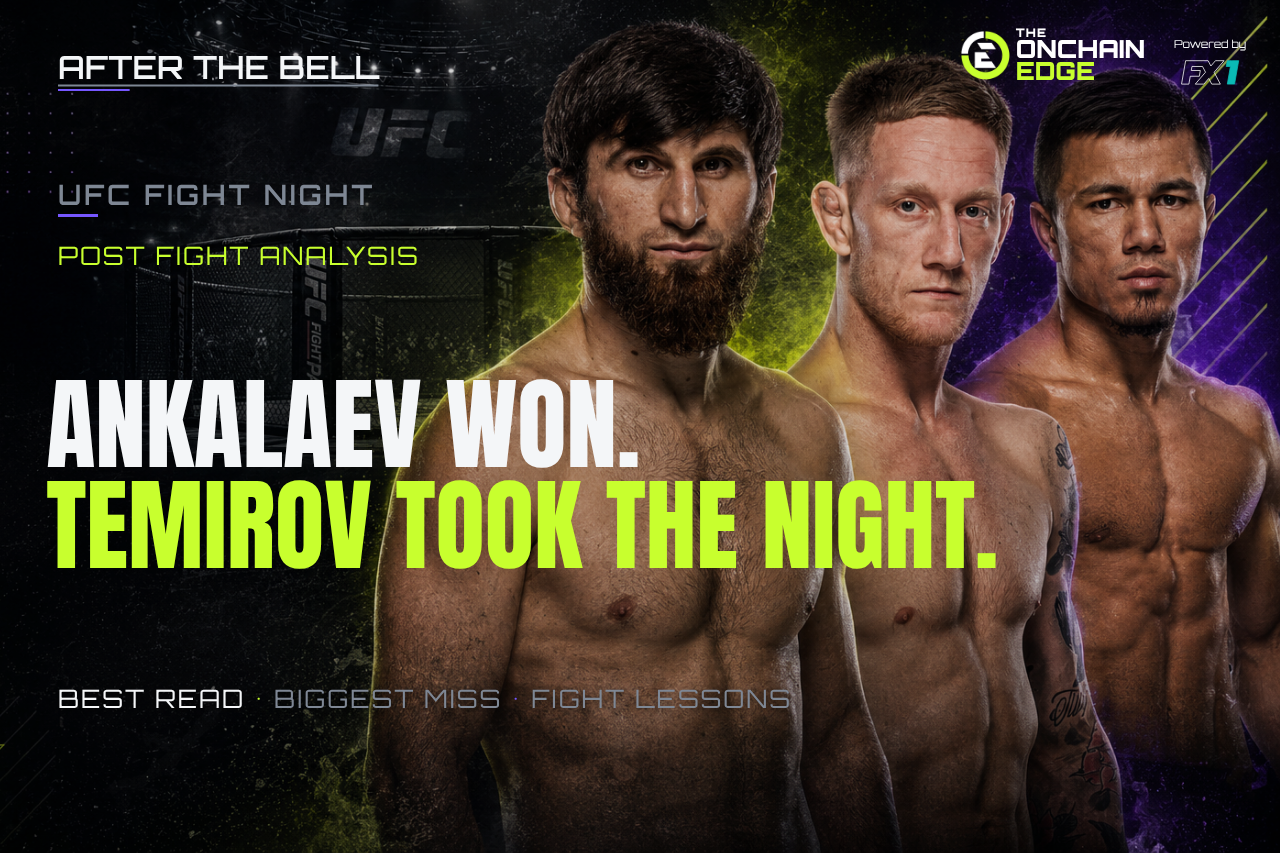
UFC Abu Dhabi ended with Magomed Ankalaev standing over an exhausted Bogdan Guskov, Marc Goddard stepping between them, and the crowd trying to decide whether they had just seen a legitimate stoppage or a fight ended by bad optics.
That debate will linger longer than most of the main event itself.
Ankalaev controlled the fight without ever making it feel urgent. Guskov stayed in it through toughness, discipline and a refusal to fall apart, then reached the fifth round with almost nothing left. Ramazan Temirov tore through Steve Erceg and turned prospect hype into something far more substantial. Sam Patterson survived an awkward opening against Santiago Ponzinibbio, found his range, and then delivered the sustained beating that his physical tools have always threatened.
Elsewhere, Nurullo Aliev imposed another exhausting wrestling performance, Valter Walker found yet another leg submission before the fight had properly settled, and several prospects left Abu Dhabi ready for significantly tougher assignments.
It was not the strongest UFC card on paper. By the end, it had given us plenty worth talking about.
Ankalaev won the fight. He did not win the room
The main event was technically controlled and emotionally flat.
Ankalaev established the terms almost immediately. He held the centre, pressed forward behind low kicks and straight punches, and gave Guskov very little room to create the reckless exchanges that represented his clearest path to victory.
Guskov did not charge forward wildly. That was probably sensible, but it also removed the one thing most likely to disrupt Ankalaev’s rhythm.
The opening rounds became a slow negotiation in which Ankalaev always held the stronger position. He touched the body and legs, landed the cleaner straight shots and forced Guskov to operate almost entirely in retreat. Guskov offered occasional counters and low kicks, but never enough volume to make Ankalaev hesitate.
There was no dramatic shift because Ankalaev never needed one.
He was not dominating every second, but he was controlling the geography of the fight. Guskov was being asked to fight at the wrong range, on the wrong rhythm, while carrying the additional burden of a five-round main event accepted on short notice.
By the fourth round, the competitive question had largely disappeared. Ankalaev added takedowns and control, further draining an opponent who had already spent most of the fight moving backwards, resetting and defending.
Guskov entered the final round needing something dramatic.
He looked like a man whose body had stopped listening.
The stoppage was frustrating, but understandable

The official result says fifth-round TKO.
That description makes the finish sound cleaner than it was.
Guskov was not flattened by one decisive shot. There was no sudden collapse, no violent knockdown and no obvious moment where consciousness left him. Ankalaev was landing unanswered punches against the fence while Guskov covered up, moved slowly and failed to show Marc Goddard enough to keep the fight going.
Optically, it looked bad.
Guskov was bloodied, exhausted and barely participating in his own defence. Goddard repeatedly asked him to fight back. Guskov did not produce a meaningful counter, clinch, angle change or escape attempt.
Once a fighter stops demonstrating intelligent defence, the referee cannot simply assume he is fine because the punches are not individually devastating.
Guskov immediately protested the stoppage, and he probably could have physically survived the remaining two minutes and nineteen seconds. He still looked aware of where he was and what was happening.
The problem was not awareness. It was the complete lack of a visible response.
A referee needs to see something. Covering up while the opponent continues punching is rarely enough, especially when the fighter already looks exhausted and compromised.
The fight may have reached the final horn had Guskov managed one proper clinch, one forceful attempt to circle away or even a short burst of offence. He did not need to turn the fight around. He only needed to convince Goddard that he was still actively defending himself.
He had nothing left with which to do it.
That is where the short-notice element becomes impossible to ignore.
Five-round fights are hard enough with a complete camp built around the distance. Guskov accepted this one with less than two weeks to prepare, then spent four rounds being made to move, reset, defend and occasionally carry Ankalaev’s weight.
His toughness got him deep into the fifth.
His conditioning could not get him out of the final bad position.
Ankalaev remains elite, but this performance did little for him
Nothing about the main event suggested Ankalaev has declined technically.
His distance management remained excellent. He stayed defensively responsible, reduced Guskov’s offence to isolated attempts and introduced grappling once the fight demanded another layer. He won every phase without placing himself in unnecessary danger.
That is high-level MMA.
It is also why the performance felt strangely unsatisfying.
Against a short-notice opponent fading badly, Ankalaev still seemed reluctant to accelerate until the final round. He remained the better fighter throughout, but rarely imposed the kind of urgency expected from someone trying to force his way back into a championship conversation.
There is a difference between controlling a fight and making an opponent feel trapped.
Ankalaev controlled the range, the pace and most of the meaningful exchanges. What was missing was the sense that Guskov was being systematically closed down.
For long stretches, Ankalaev was content to stay comfortably ahead rather than push the fight towards a conclusion.
The finish eventually came, but it was created as much by Guskov’s exhaustion as Ankalaev’s offence.
Ankalaev remains one of the most complete light heavyweights in the world. This fight did not weaken that case. It simply failed to add much to it.
Temirov did not beat Erceg. He overwhelmed him

The co-main event was the biggest correction of the night.
The expectation was that Steve Erceg’s experience, length and exposure to elite opposition would allow him to manage Ramazan Temirov’s aggression, survive the early danger and begin building a more technical fight.
None of that happened.
Temirov opened with spinning attacks, closed distance immediately and refused to let Erceg settle into the kind of measured rhythm the matchup required.
Even when the first burst failed to produce the finish, the message was obvious. Erceg would not be given time to collect information, establish the jab or slowly adjust to the speed of the fight.
Temirov was faster into range, more forceful in the exchanges and far more comfortable in the chaos.
Erceg did land. He found moments with the jab and caught Temirov during some of his more aggressive entries. The problem was that Temirov absorbed those shots without surrendering momentum.
Every exchange seemed to increase his confidence.
Once the right hand began landing cleanly, the fight became a chase.
Erceg was dropped, recovered to his feet, hurt again and eventually knocked face-first to the canvas late in the opening round. There was no debate around the stoppage. Temirov closed the argument completely.
Erceg was not edged out by a dangerous prospect.
He was dominated.
Temirov justified the hype
The case for Erceg was built on evidence.
He had fought Alexandre Pantoja, Brandon Moreno and Kai Kara-France. He had operated at a level Temirov had never experienced. Normally, that kind of proven performance against elite opposition deserves considerable weight.
The mistake was treating Temirov’s lack of top-level experience as proof that he was not ready.
There was too little information available to establish his ceiling.
That should have made the fight harder to judge than it initially appeared.
Temirov’s previous performances showed speed, aggression, power and an obvious appetite for chaos. What they had not shown was whether those traits would hold up against a technical opponent who had already competed at championship level.
They did more than hold up.
Temirov made Erceg look completely outmatched.
Calling a fighter world class after one major win can become reckless, but this was not a narrow decision or a fortunate finish. Temirov imposed himself from the opening seconds and never allowed Erceg to establish a foothold.
The flyweight division now has another serious problem.
Temirov still needs to prove he can maintain the same effectiveness in a slower fight, against an opponent who survives the first-round storm and forces him to operate beyond his preferred pace.
That question remains.
The hype no longer needs to be defended.
Patterson survived the awkward bit and then became the bully
Santiago Ponzinibbio had moments.
He was active early, beat Patterson to some of the opening exchanges and created enough discomfort to remind everyone why a veteran with his timing and power cannot simply be dismissed.
For a while, Patterson looked like the version of himself that invites trouble.
He stood tall, left his chin available and allowed Ponzinibbio to build confidence with wide entries. That was the concern coming into the fight. Patterson has enormous physical gifts, but he can make himself hittable enough to give technically experienced opponents a route back into the contest.
The opening exchanges were not comfortable.
Then Patterson settled down.
He stopped reacting to every feint, found the range and began meeting Ponzinibbio with straighter, cleaner combinations. His length became less of a physical measurement and more of an active weapon.
Ponzinibbio was still swinging, but Patterson was reading the attacks earlier and returning with greater accuracy.
The second round was where the age, size and momentum differences became impossible to ignore.
Patterson walked him down, stayed composed in the exchanges and began landing combinations rather than isolated shots. Ponzinibbio was hurt, allowed back to his feet and immediately pressured again.
Patterson did not lose control in pursuit of the finish.
He simply resumed the beating.
Another clean right hand eventually put Ponzinibbio down and forced the stoppage.
This was the version of Sam Patterson that makes welterweight uncomfortable.
Not the long fighter content to pick at range. Not the awkward prospect waiting for the perfect opening. The aggressive, physically imposing fighter who recognises when an opponent is beginning to fold and refuses to let him recover.
Ponzinibbio’s early success made the performance more meaningful.
Patterson was tested, adjusted and then took over.
That tells us far more than another effortless first-round demolition would have done.
Aliev remains brutally predictable, and that is a compliment
Nurullo Aliev did exactly what Nurullo Aliev does.
He pursued takedowns, chained attempts together, stayed attached during scrambles and forced Mike Davis to spend most of the fight solving the same exhausting problem.
Davis had some good moments. He threatened from guard, landed elbows and made Aliev work harder than the scorecards might suggest.
The broader shape of the fight never changed.
Aliev repeatedly put Davis back into defensive wrestling sequences. Even when Davis stood, escaped or created a brief submission threat, Aliev remained close enough to restart the cycle.
There was no need for reinvention.
That is the strength of Aliev’s game. Opponents know what is coming. They can prepare specifically for it. They can defend the first attempt and sometimes the second.
Then the third arrives.
That is followed by the clinch, the mat return and another minute disappearing from the round.
It may never become everyone’s preferred viewing, but it is an exceptionally reliable way to win UFC fights.
The next test needs to be against someone who can punish those entries consistently enough to make Aliev hesitate.
So far, nobody has managed it.
Valter Walker has turned one attack into an identity
Valter Walker submitted Thomas Petersen with a calf slicer after only 92 seconds, extending a ridiculous sequence of first-round leg-lock finishes.
At this stage, opponents are not being surprised by the idea of Walker attacking the legs.
They are being surprised by how quickly the position becomes terminal.
That changes the strategic burden of fighting him. Heavyweights cannot casually engage in scrambles, allow their legs to become entangled or assume they will have time to recognise the danger.
Walker does not need prolonged control.
He needs one messy transition.
The obvious question is what happens when a higher-level opponent refuses the grappling exchanges, stays disciplined and forces him to win minutes on the feet.
That remains unanswered.
What has already been established is that his specialist threat is not a novelty. It is a repeatable UFC-level weapon, and it is producing finishes before opponents can establish any meaningful offence.
Heavyweight is not a division filled with sophisticated leg-lock defence.
Walker has found an area of the game where he is operating several steps ahead of most of the field.
What Abu Dhabi actually told us
The most important lesson from this card was not about one specific technique or one particular fighter.
It was about uncertainty.
Erceg had the stronger body of work. Temirov had the more dangerous unanswered question.
Guskov had the toughness to survive deep into the fifth round. He did not have the preparation or energy to prove it to the referee when the fight reached its ugliest moment.
Ponzinibbio had enough craft to create early success. Patterson had the youth, size and composure to make those moments irrelevant once the fight extended.
Aliev and Walker showed the value of having one clearly defined area of dominance. Neither man needs to be complete yet because opponents are still failing to solve the thing they already do best.
Post-fight analysis becomes useless when every unexpected result is explained away as luck.
Temirov did not get lucky.
He was faster, more aggressive and more dangerous than Erceg from the opening seconds.
Guskov was not robbed.
He was exhausted, inactive and left the referee with an easy visual decision, even if the actual damage was less dramatic than the stoppage looked.
Patterson did not simply beat an older fighter.
He absorbed early resistance, adjusted and then imposed himself with increasing authority.
Those are the details that matter once the official results have been recorded and the noise has died down.
Final word
UFC Abu Dhabi did not produce a classic main event.
It produced something more useful.
Ankalaev remains elite, even if his route back to the belt still lacks momentum. Guskov proved he is tough enough for five-round company, but short notice and championship distance are a savage combination.
Temirov is no longer just an explosive prospect with an exciting record. He now has a ranked scalp and a performance that demands attention.
Patterson may have found the balance between aggression and control that his physical tools have always promised.
Aliev remains relentless. Walker remains deeply unpleasant to grapple with.
The card was not flawless, but it left the divisions involved looking a little different than they did before the first fight began.
That is enough to make the night worthwhile.
The Onchain Edge is independently produced and is not an official FX1 publication.


Leave a Reply