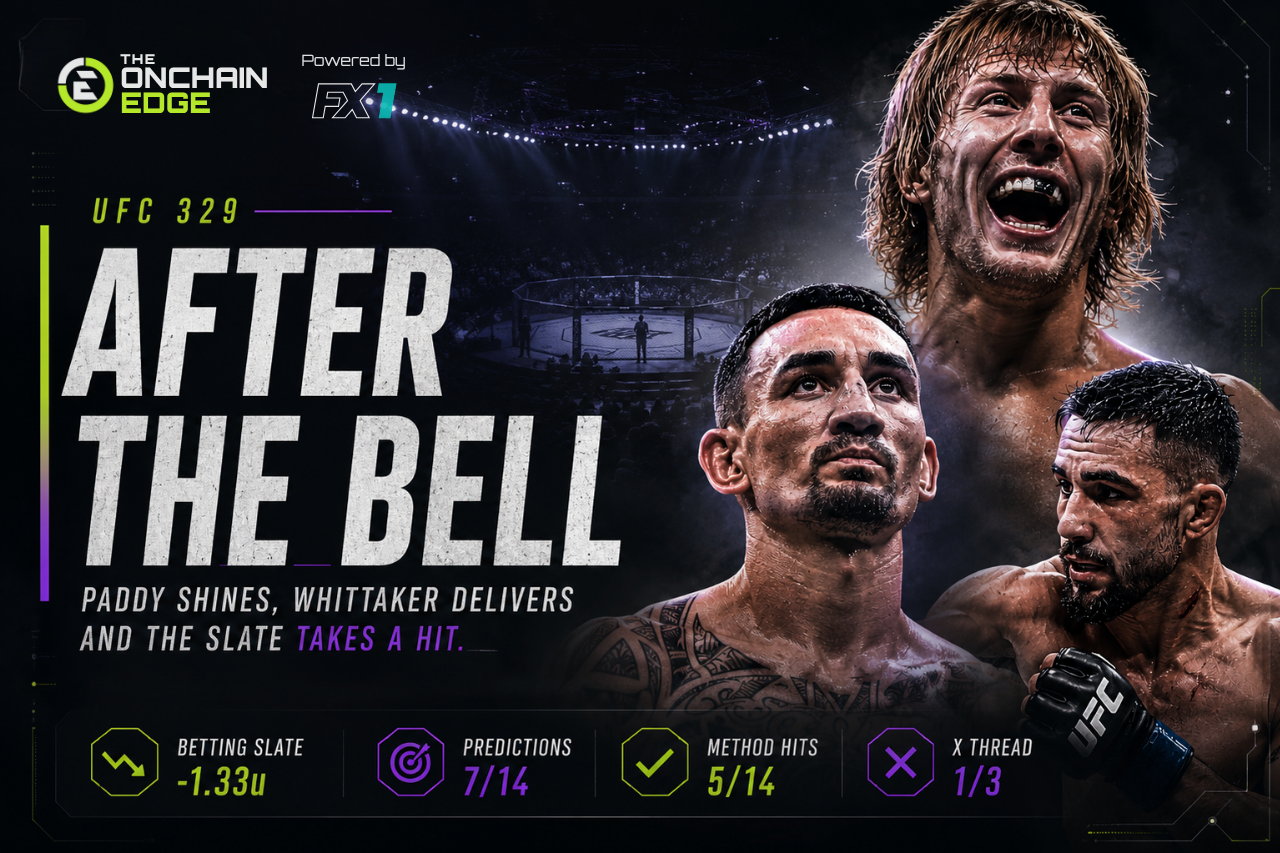
UFC 329 did not wait around to make a mess of the script.
The main event lasted 69 seconds and told us almost nothing about how Max Holloway and Conor McGregor would have matched up over five rounds. The co-main event lasted even less, but told us plenty about Paddy Pimblett.
Further down the card, Mario Bautista imposed exactly the kind of physical fight we knew could trouble Cory Sandhagen, while Robert Whittaker reminded everyone that superior technique does not disappear just because the weight class changes.
The final numbers were not pretty:
| Measure | Result |
|---|---|
| Betting Slate | -1.33u |
| Full-card winner predictions | 7/14 |
| Official winner and method hits | 5/14 |
| X thread selections | 1/3 |
There were some strong reads, some poor ones and one winner that landed without proving the original argument.
That is why the result alone never tells the full story.
Holloway Won, but We Learned Almost Nothing
Our strongest position was Max Holloway by KO/TKO at 1.86.
Officially, it landed.
McGregor attempted a jumping roundhouse kick almost immediately, landed awkwardly on his right leg and suffered a knee injury. He tried to continue, but the fight was stopped at 1:09 of the opening round and recorded as a Holloway TKO victory.
The bet cashed. The analysis did not get tested.
Our argument was that McGregor remained dangerous early, but Holloway’s pace, durability and activity would begin taking over once the fight moved beyond that initial window.
We expected attrition. We got an injury.
There is no need to hand the money back, but there is also no point pretending Holloway proved the read correct. He barely had time to start fighting.
The result leaves the biggest questions unanswered.
Could McGregor still carry his speed and power through the opening exchanges? Would Holloway have been able to increase the pace? Would five years away have caught up with McGregor once the fight became uncomfortable?
We still do not know.
Holloway leaves UFC 329 with an official win. McGregor leaves with another serious injury. Anyone claiming they learned much about the matchup itself is reaching.
Paddy Did Not Survive the Chaos. He Owned It.
The Paddy Pimblett position was Paddy by decision at 5.50.
The method was completely wrong.
The wider argument that the market was underrating Paddy’s grappling danger was emphatically right.
Saint Denis opened aggressively, but Pimblett immediately turned the first meaningful grappling exchange into a D’Arce choke. Saint Denis went unconscious just 52 seconds into the fight.
We spent much of the build-up discussing whether Paddy could survive Saint Denis’ early pressure and make the later rounds competitive.
He had no interest in waiting that long.
This was not Paddy hanging around, weathering a storm and stealing rounds. He met Saint Denis in the exact phase where the Frenchman was supposed to hold the advantage and finished him almost immediately.
That matters.
Pimblett’s grappling is still treated strangely. People acknowledge that he is dangerous, then assess his matchups as though opponents can wrestle with him without consequence.
Saint Denis found out otherwise.
The betting lesson is more uncomfortable.
We identified the right fighter at an underdog price, but narrowed the bet to a decision because we expected Saint Denis to be difficult to finish and believed Paddy’s strongest path developed later.
That extra precision turned a strong winner call into a losing ticket.
The answer is not to abandon method markets. They are often where the best value sits. But when an underdog has several credible routes, there is a point where chasing the bigger number becomes unnecessarily clever.
Paddy made the market look foolish.
Unfortunately, he also made our method pick look foolish.
Bautista Made Us Pay for Ignoring Our Own Warning
Our Sandhagen analysis recognised the threat.
Bautista’s pressure, clinch work, takedown activity and ability to force ugly exchanges were all identified before the fight.
We still backed Sandhagen by decision at 2.70.
Bautista won every official scorecard 29-28. He damaged Sandhagen’s leg early, attacked through grappling transitions and maintained enough pressure and aggression to stop Sandhagen establishing the clean long-range fight we expected.
This was not a robbery or a coin-flip decision that happened to go against us.
Bautista produced the more effective performance.
Sandhagen had moments, but the fight was consistently shaped by Bautista’s physicality. The leg damage reduced Sandhagen’s mobility and made every later exchange more difficult.
The mistake was not failing to recognise Bautista’s route.
The mistake was recognising it and still assuming Sandhagen’s technical variety would be enough to overcome it.
Sometimes the cleaner striker does not get enough clean striking time.
That was the fight.
Whittaker Was Not Too Small. He Was Too Sharp.
The Krylov Bet Builder was the most aggressive value play on the slate:
Nikita Krylov to win and the fight not to go the distance at 3.30.
The price was appealing because Krylov had clear physical advantages and several finishing routes. He was the natural light heavyweight, the larger man and the more active grappling threat.
Whittaker made those arguments irrelevant.
Krylov had some early success imposing his wrestling and forcing Whittaker to adjust, but the former middleweight champion remained composed. As the fight developed, Whittaker’s speed, jab and accuracy began separating them.
In the third round, two right hands badly hurt Krylov and forced the stoppage at 1:01.
The size difference existed.
It simply did not decide the fight.
Whittaker looked fast, powerful enough for the division and technically several levels cleaner. Krylov’s route required him to make the contest physical and chaotic for sustained periods. He could not maintain that pressure without repeatedly giving Whittaker the striking openings he needed.
There is nothing clever to salvage here.
The underdog had a plausible route and the price justified taking a position, but the actual read lost. Whittaker adapted better, defended well enough and punished Krylov whenever the fight returned to range.
The market was right.
Yanez Was the Cleanest Read on the Slate
Not every method bet missed.
Adrian Yanez stopped Cody Garbrandt in the opening round, completing the Holloway KO/TKO and Yanez KO/TKO double at 3.46. Yanez found the finish at 2:47.
This was the most complete read of the night.
Garbrandt remains fast and dangerous, but he has repeatedly accepted extended boxing exchanges against opponents equipped to punish him. Yanez had the volume, timing and power to make that habit costly.
He did exactly that.
Unlike the Holloway leg of the double, Yanez’s result matched the expected fight script.
That double returned enough to soften the overall loss, but it could not rescue a slate where three of the four core singles failed.
Full Betting Slate Results
Core Value Bets
| Bet | Stake | Result | Profit/Loss |
|---|---|---|---|
| Holloway by KO/TKO at 1.86 | 1.25u | Won | +1.08u |
| Pimblett by decision at 5.50 | 1.00u | Lost | -1.00u |
| Krylov to win and fight not to go the distance at 3.30 | 0.75u | Lost | -0.75u |
| Sandhagen by decision at 2.70 | 0.75u | Lost | -0.75u |
| Core singles total | 3.75u | -1.43u |
Doubles
| Bet | Stake | Result | Profit/Loss |
|---|---|---|---|
| Holloway KO/TKO + Yanez KO/TKO at 3.46 | 0.75u | Won | +1.85u |
| Sandhagen ML + Cortez ML at 3.31 | 0.75u | Lost | -0.75u |
| Doubles total | 1.50u | +1.10u |
Hail Mary Parlays
| Bet | Stake | Result | Profit/Loss |
|---|---|---|---|
| Holloway R4 KO/TKO + Paddy decision | 0.50u | Lost | -0.50u |
| McKinney submission + Kamaka decision + Costa KO/TKO | 0.25u | Lost | -0.25u |
| Kamaka decision + Cortez decision + Paddy decision | 0.25u | Lost | -0.25u |
| Hail Mary total | 1.00u | -1.00u |
Final Slate Result
| Category | Risk | Profit/Loss |
|---|---|---|
| Core singles | 3.75u | -1.43u |
| Doubles | 1.50u | +1.10u |
| Hail Mary parlays | 1.00u | -1.00u |
| Total | 6.25u | -1.33u |
The slate returned 4.92 units from 6.25 units staked, finishing with a loss of 1.33 units.
Not a disaster. Not good enough either.
Full-Card Prediction Scorecard
The original Fight Lab article included a winner and likely method for all 14 fights.
| Fight | Prediction | Actual Result | Winner Correct? |
|---|---|---|---|
| McGregor vs Holloway | Holloway by KO/TKO | Holloway, R1 TKO injury | ✅ |
| Saint Denis vs Pimblett | Pimblett by decision | Pimblett, R1 submission | ✅ |
| Sandhagen vs Bautista | Sandhagen by decision | Bautista, decision | ❌ |
| Royval vs Kavanagh | Kavanagh by decision | Royval, R3 submission | ❌ |
| Green vs McKinney | McKinney by KO/TKO | Green, R1 TKO | ❌ |
| Krylov vs Whittaker | Krylov inside distance | Whittaker, R3 TKO | ❌ |
| Steveson vs Ellison | Steveson by KO/TKO | Steveson, R1 KO | ✅ |
| Garbrandt vs Yanez | Yanez by KO/TKO | Yanez, R1 TKO | ✅ |
| Riley vs Kamaka | Kamaka by decision | Riley, R1 TKO | ❌ |
| Cortez vs Wang | Cortez by decision | Wang, decision | ❌ |
| Pinas vs Almeida | Pinas by KO/TKO | Pinas, R1 KO | ✅ |
| Basharat vs Garza | Basharat by decision | Basharat, decision | ✅ |
| Gandra vs Reese | Reese by submission | Gandra, R1 TKO | ❌ |
| Costa vs Durden | Costa by KO/TKO | Costa, R2 submission | ✅ |
Prediction Totals
- Correct winners: 7/14
- Winner accuracy: 50%
- Official winner and method hits: 5/14
- Official method accuracy: 35.7%
Even the five official method hits need context.
Holloway was recorded as a TKO winner, but the injury had nothing to do with the attritional finish we predicted. The four clean winner-and-method reads were Steveson, Yanez, Pinas and Basharat.
The Real Structural Mistake
The biggest lesson was not simply that several bets lost.
It was that the slate contained more concentrated method exposure than it appeared to.
Paddy by decision appeared:
- As a core single
- In the Holloway round-four double
- In the underdog decision parlay
Kamaka by decision appeared in two longshots.
Cortez featured:
- On the moneyline in a double
- By decision in a longshot
On paper, those were separate bets. Underneath, several depended on the same fight scripts.
When Paddy won by submission, we were right about the fighter and still lost three positions.
When Riley stopped Kamaka, two longshots disappeared.
When Wang outworked Cortez to a unanimous decision, the second double and another longshot were gone.
The weekly structure did its job by keeping those parlays small. The damage was contained.
The selection process still needs to be sharper about duplicated outcomes.
A 0.25-unit parlay is small in isolation. Three bets leaning on the same method can quietly turn one wrong assumption into a much larger problem.
What Carries Forward
UFC 329 gave us five useful conclusions.
Paddy’s grappling deserves more respect. Not vague recognition. Real respect when pricing fights involving aggressive wrestlers who leave their neck exposed.
Whittaker’s move to light heavyweight worked. The physical concerns were reasonable, but his speed and technique travelled up with him.
Bautista can dictate fights against elite opposition. His pressure is not just activity. It creates damage, control and increasingly poor decisions from the man opposite him.
Yanez remains lethal when given the boxing match he wants. Garbrandt gave it to him and paid for it.
Method props need room to be wrong. When the fighter has multiple credible winning routes, taking the bigger number can sometimes mean betting against your own broader analysis.
Final Word
UFC 329 finished with a losing slate and a perfectly average 7-7 prediction record.
There is no point dressing that up.
But the card was not empty.
Paddy showed that the market had underestimated how dangerous he was in the grappling exchanges. Whittaker shut down the idea that moving to light heavyweight would automatically make him vulnerable to a larger, more physical opponent. Bautista proved that pressure can beat polish when it is backed by damage and control.
Holloway got the official win, but the fight gave us no answers.
The slate took a hit.
The next one gets built with better information.


Leave a Reply