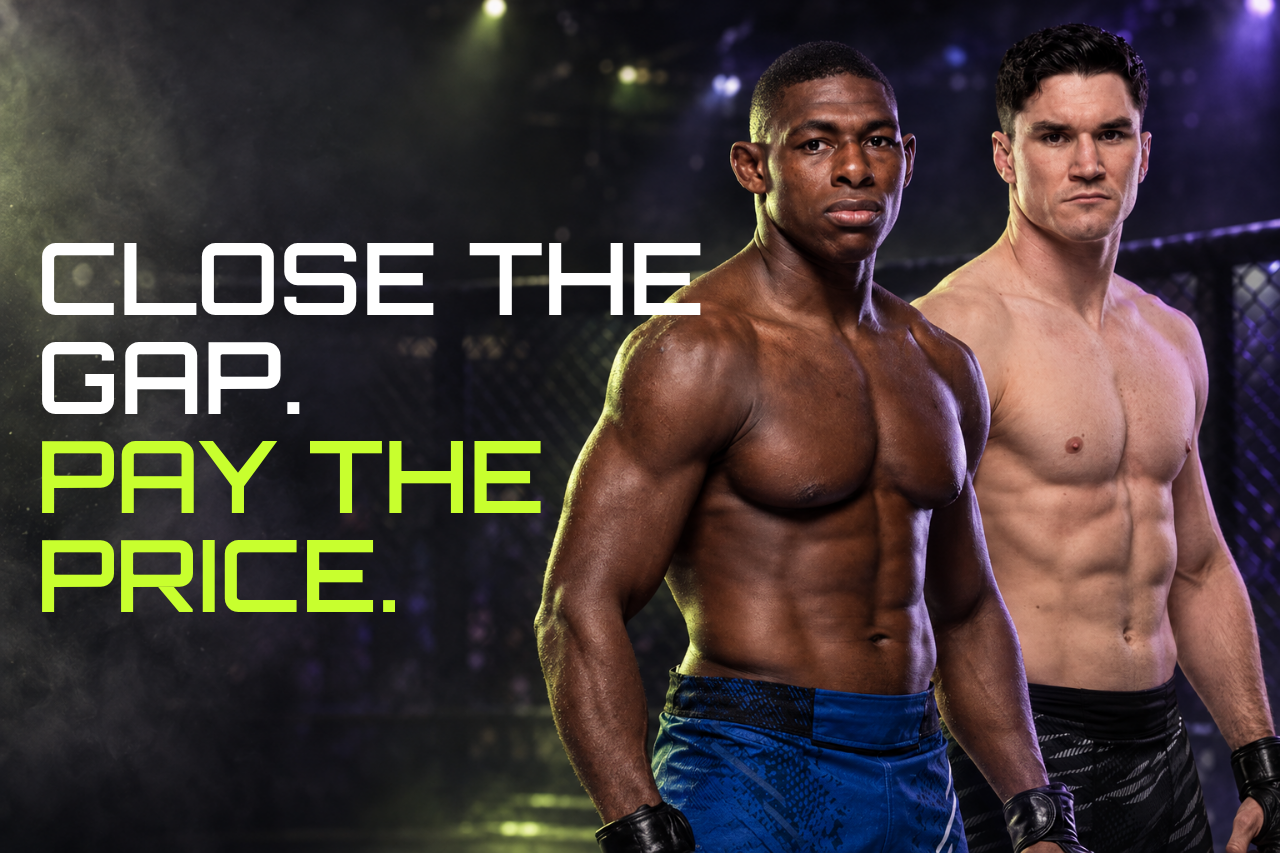
Joaquin Buckley has spent his last two fights being shown exactly where opponents want to attack him.
Kamaru Usman and Sean Brady both found sustained success by taking away his preferred striking exchanges and forcing him to work from underneath. Mike Malott has enough grappling to make that impossible to ignore.
The question is whether he can get there often enough without paying for it.
The Model favours Buckley at 61.5%, and the final read agrees. Elsewhere, Erin Blanchfield owns the strongest number of the week, Kyle Daukaus has the broader skill set against Marc-Andre Barriault, Louis Jourdain looks capable of producing something more decisive than the numbers suggest, and the biggest disagreement comes in Nallo vs Landwehr.
MAIN EVENT · WELTERWEIGHT
JOAQUIN BUCKLEY VS MIKE MALOTT

THE MODEL
Buckley
61.5%
EDGE PICK
Buckley
METHOD
KO/TKO
Buckley is the more proven fighter at the highest level, and that carries weight in a five-round main event.
Malott is the more rounded threat on paper. He can strike, wrestle and threaten submissions, which gives him several ways to make Buckley hesitate before committing to his offence.
FIGHT INTEL
JOAQUIN BUCKLEY
MIKE MALOTT
76"
REACH
73"
36%
SIG. STRIKEs ACCURACY
48%
70%
takedown defence
57%
0.10
submission attempts / 15 MIN
0.70
Those numbers show why this is not simply a puncher against a grappler.
Malott lands a higher percentage of his significant strikes, offers the greater submission threat and has enough wrestling to test the weakness Buckley has shown in consecutive fights.
The best version of Malott here is one that blends those phases together.
Use the jab, force Buckley to react to the hands, then connect the wrestling behind it. If Malott shoots from too far away or becomes predictable with his entries, Buckley gets exactly the sort of opening he wants.
That is where the danger starts.
Buckley carries serious power, and he does not need many clean opportunities to change a fight. Despite being the shorter man, he also owns a three-inch reach advantage, giving him more room to punish Malott on the way in than the height difference might suggest.
Malott can absolutely win minutes through volume and control. If he can repeatedly put Buckley against the fence, make him defend and force him to carry weight, the American’s offence becomes much easier to manage.
The problem is maintaining that for five rounds.
Buckley has shown a better ability to stay dangerous late, and his résumé gives more confidence that he can keep producing against high-level opposition as the fight gets difficult.
Malott has improved since the Neil Magny defeat, but that remains the clearest warning about what can happen when his early success starts costing energy.
The pick is Buckley surviving enough of the grappling exchanges to keep resetting the fight.
Once they are back in open space, the power difference becomes much harder to ignore.
THE MODEL PICK: JOAQUIN BUCKLEY 61.5%
THE EDGE PICK: JOAQUIN BUCKLEY BY KO/TKO
FEATURED FIGHT · women’s flyweight
Erin Blanchfield vs Jasmine Jasudavicius

THE MODEL
Blanchfield
86.7%
EDGE PICK
Blanchfield
METHOD
Decision
Blanchfield carries the biggest model number on the card, but Jasudavicius is exactly the kind of opponent who can make an 86.7% favourite look uncomfortable.
This is not a simple wrestler-versus-striker matchup. Jasudavicius has strong wrestling numbers of her own and should be capable of making large stretches of this fight physically demanding.
FIGHT INTEL
Erin Blanchfield
Jasmine Jasudavicius
+0.99
Sig. strike differential / min
-0.01
1.96
TAKEDOWNS / 15 MIN
2.63
34%
TAKEDOWN ACCURACY
46%
78%
Takedown defence
75%
Jasudavicius actually averages more takedowns per 15 minutes than Blanchfield and converts them at a higher rate.
Their defensive wrestling numbers are also close.
There is no real statistical case for assuming Blanchfield simply decides to grapple and immediately takes control.
The difference is what happens once positions start changing.
Blanchfield is more dangerous from both top and bottom, more comfortable attacking through scrambles and more capable of turning a neutral grappling exchange into something meaningful.
Her striking has improved too.
She carries the much healthier striking differential, giving her another route if the wrestling becomes competitive rather than dominant.
Jasudavicius can keep this close by making the fight physical.
She is tough, strong in the clinch and capable of forcing long wrestling exchanges. If she can secure positions, slow Blanchfield down and make her work before creating offence, she can bank rounds without needing to dominate every minute.
The issue is that Blanchfield appears to have more ways to respond.
If the takedown is not there, she can strike. If she ends up underneath, she can create scrambles. If Jasudavicius gives her space on the mat, Blanchfield immediately becomes dangerous.
There is also still a sense that Blanchfield has more development ahead of her. She is younger, still improving and has already shown she can beat high-level opposition in different ways.
Jasudavicius should make her work.
But Blanchfield looks better equipped to keep producing offence regardless of where the fight spends most of its time
THE MODEL PICK: ERIN BLANCHFIELD 86.7%
THE EDGE PICK: ERIN BLANCHFIELD BY DECISION
FEATURED FIGHT · MIDDLEWEIGHT
Marc-Andre Barriault vs Kyle Daukaus

THE MODEL
Daukaus
72.7%
EDGE PICK
Daukaus
METHOD
Decision
METHOD SPLIT
The Model favours Daukaus at 72.7%, with submission its preferred method. The final read agrees on the winner but expects Barriault to survive long enough to reach the scorecards.
Barriault remains exactly the kind of fighter who can make a technically cleaner opponent work harder than expected.
He is tough, aggressive and willing to turn fights into ugly exchanges. Daukaus has the broader skill set, but accessing the grappling cleanly is the important part.
FIGHT INTEL
Marc-Andre BarriaulT
Kyle Daukaus
49%
Sig. strike defence
42%
0.34
TAKEDOWNS / 15 MIN
1.97
28%
TAKEDOWN
25%
0.10
Submission attempts / 15 min
2.00
The grappling difference is obvious.
Daukaus averages far more takedowns and produces considerably more submission activity.
But his takedown accuracy is only 25%.
That matters here.
Barriault does not need to be the better grappler. He simply needs to make failed attempts expensive. If Daukaus repeatedly shoots without establishing control, Barriault gets chances to make him work in the clinch and punish him on the break.
That is why the submission call feels less secure than the winner call.
Daukaus does not need to force the finish.
He can use the threat of the takedown to disrupt Barriault’s pressure, slow the pace and stop the Canadian from settling into the prolonged striking exchanges he prefers.
His striking has improved enough that he should not need to spend the entire fight desperately chasing the mat.
Barriault can still create problems if he turns this into a brawl.
He remains durable, gritty and willing to walk opponents down, but the combination of declining form, defensive openings and Daukaus’s grappling threat makes him difficult to trust across three rounds.
Daukaus should have enough control over where the fight takes place to keep Barriault from consistently imposing the pressure he needs.
The submission may appear.
The slightly safer call is Daukaus accumulating enough control, cleaner work and positional success to take the decision.
THE MODEL PICK: KYLE DAUKAUS 72.7%
THE EDGE PICK: KYLE DAUKAUS BY DECISION
FEATURED FIGHT · BANTAMWEIGHT
Louis Jourdain vs Timmy Cuamba

THE MODEL
Jourdain
52.8%
EDGE PICK
Jourdain
METHOD
KO/TKO
METHOD SPLIT
The Model only narrowly favours Jourdain and leans towards decision. The final read agrees on the winner but sees a stronger finishing route through Jourdain’s range management, kicks and cleaner striking.
This is one of the closest winner predictions among the featured fights.
Cuamba has a credible wrestling route, but the final read depends heavily on whether he is willing to use it consistently.
FIGHT INTEL
Louis Jourdain*
Timmy Cuamba
7.32*
SIG. STRIKES LANDED/MIN
2.88
2.44
Sig. strikes absorbed / min
3.72
0.00
Takedowns / 15 min
1.18
1.40
Submission attempts / 15 min
0.00
*Jourdain’s statistical sample is limited and should not be treated as a settled UFC rate
The raw numbers favour Jourdain’s striking heavily, but the sample needs context.
The way he produces that offence is more useful than pretending the 7.32 figure is already an established UFC baseline.
Jourdain looks like the cleaner and more varied striker, particularly at range. His kicks give Cuamba plenty to deal with before the hands even start landing, and he has shown a better ability to layer attacks rather than relying on one obvious entry.
Cuamba’s wrestling is the clearest threat.
He averages more than one takedown per 15 minutes and has enough physicality to make Jourdain uncomfortable if he commits to that route.
The question is whether he will.
Cuamba has not consistently built his fights around wrestling, and that matters here. If he spends too much time exchanging at distance, Jourdain should have the cleaner weapons and better range management.
The style matters more than the headline striking rate.
Jourdain is polished, patient and capable of attacking at different levels. The kicks should be particularly valuable against an opponent who may be reluctant to wrestle often enough.
Cuamba needs to make Jourdain uncomfortable early.
That means closing distance, forcing clinches and making him think about defending takedowns before settling into his own striking rhythm.
If he does that consistently, this becomes much closer to the model’s near-even projection.
If he does not, Jourdain should gradually take control of the exchanges.
The final call is more aggressive than the model’s method lean.
Cuamba’s defensive openings, combined with Jourdain’s variety and cleaner work at range, create enough opportunity for a finish before the final horn.
THE MODEL PICK: LOUIS JOURDAIN 52.8%
THE EDGE PICK: LOUIS JOURDAIN BY KO/TKO
FEATURED FIGHT · LIGHTWEIGHT
Mandel Nallo vs Nate Landwehr

THE MODEL
Nallo
50.6%
FINAL PICK
Landwehr
METHOD
KO/TKO
Model SPLIT
The Model gives Nallo the narrowest of edges at 50.6%. The final read flips to Landwehr, trusting his pressure, toughness and move to lightweight enough to take the other side of an almost even matchup.
This is the biggest winner disagreement among the five featured fights.
Nallo has the cleaner early offence and the statistical advantages at range. The question is how much confidence to place in those advantages once the fight becomes ugly.
FIGHT INTEL
Mandel Nallo*
Nate Landwehr
75″
REACH
72"
8.26
SIG. STRIKES LANDED/MIN
5.55
5.03
SIG. STRIKES ABSORBED/MIN
5.96
58%
SIG. STRIKE ACCURACY
45%
*Nallo’s rates come from a very small sample.
The numbers favour Nallo’s early offence.
He owns the longer reach, has landed at the higher rate and has been considerably more accurate in the limited recorded sample.
There is no point hiding that just because the final pick goes the other way.
Nallo is dangerous.
His finishing record is excellent, and he can hurt opponents quickly. The concern is what happens when the fight does not end immediately.
His UFC debut against Jai Herbert showed how quickly a promising start can turn against him. Nallo can absolutely hurt people, but his own durability is difficult to completely trust.
Landwehr comes with an even more obvious warning sign.
He has been stopped in three consecutive fights and absorbs almost six significant strikes per minute. That is hardly reassuring against someone as dangerous early as Nallo.
The case for Landwehr is therefore not statistical safety.
It is about the kind of fight he can force.
Landwehr is relentless, willing to walk through difficult moments and comfortable fighting at a pace that makes opponents stay switched on.
The move to lightweight may help too.
A less demanding weight cut could allow him to carry that pressure more effectively, while giving him the chance to fight without having to drain himself down to featherweight.
Nallo should have the cleaner moments early.
His length and accuracy give him every opportunity to punish Landwehr as he tries to close distance.
But Landwehr’s route is to survive that opening threat, keep forcing exchanges and make Nallo prove he can continue producing once the fight becomes physically uncomfortable.
That is where the final read separates from The Model.
Nallo may be the cleaner technical threat.
Landwehr is the fighter more trusted to survive the bad moments and still be dangerous once the fight turns messy.
There is very little confidence separating them.
The narrow pick is Landwehr forcing enough chaos to eventually find the finish.
THE MODEL PICK: MANDEL NALLO 50.6%
THE EDGE PICK: NATE LANDWEHR BY KO/TKO
The Final Read
The Model and the final picks are mostly aligned this week, but the method calls create some useful differences.
Buckley gets the main-event nod because he has the stronger résumé, more proven late-fight output and enough power to punish Malott whenever the wrestling breaks down.
Blanchfield is the strongest winner selection of the five, although Jasudavicius should make the grappling much more competitive than the headline percentage might imply.
Daukaus is another agreement on the winner, but not the method. The Model prefers submission. The final read gives Barriault enough credit for durability and resistance to lean towards the scorecards.
Jourdain also gets a more aggressive method call. Cuamba’s wrestling can change the fight, but only if he commits to it often enough.
Then there is Landwehr.
The Model narrowly favours Nallo. The final read trusts Landwehr’s toughness, pressure and move to lightweight enough to take the other side.
That is the clearest disagreement this week.
The full card will be covered in Picks, while Edge Games gives everyone else the chance to make their own call before fight night.
BUCKLEY vs MALOTT Buckley by KO/TKO
BLANCHFIELD vs JASUDAVICIUS Blanchfield by Decision
BARRIAULT vs DAUKAUS Daukaus by Decision
JOURDAIN vs CUAMBA Jourdain by KO/TKO
NALLO vs LANDWEHR Landwehr by KO/TKO


