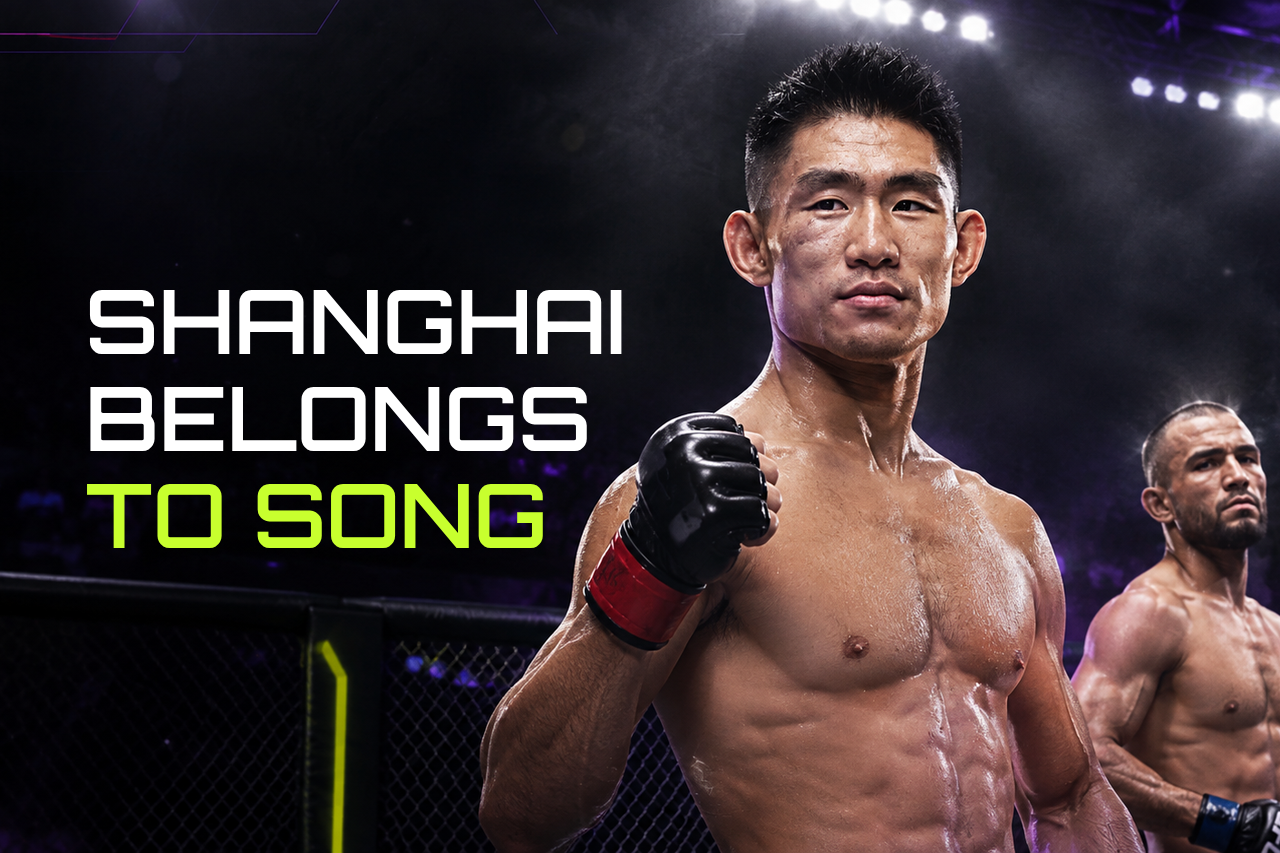
The script looked straightforward enough before the cage door closed. Gregory Rodrigues would be dangerous early, Anthony Hernandez would make him wrestle, the pace would begin to tell, and somewhere in the championship rounds Robocop would either be surviving underneath him or finally giving up the submission.
Rodrigues tore that script to pieces.
He defended 25 of Hernandez’s 28 takedown attempts, battered the lead leg throughout the fight and kept enough offence coming deep into the fifth to earn a unanimous decision, 49-46 and 48-47 twice. Hernandez had his best spell in the third and still found periods of control, but Rodrigues never reached the point where the pressure became overwhelming. Instead, he repeatedly separated, reset and went straight back to hurting him.
This was not Robocop landing one enormous shot and escaping with the win. It was a 25-minute performance against the exact style that was supposed to expose him.
Rodrigues Solved the Problem
Hernandez’s wrestling numbers almost tell the whole story. Twenty-eight attempts would normally be evidence that Fluffy had dragged another opponent into his world. Against Rodrigues, only three became completed takedowns.
That changed everything.
Hernandez could still force clinches and make Rodrigues work, but the usual chain never developed consistently enough. Rodrigues was able to get back to distance, where the calf kicks and right hands kept landing. He scored multiple knockdowns from the leg attacks alone and, crucially, was still pressing forward and throwing in rounds four and five rather than merely trying to survive them.
The pre-fight concern was Rodrigues’ ability to survive Hernandez’s pace. The better question turned out to be whether Hernandez could keep absorbing Rodrigues’ offence while repeatedly failing to turn entries into sustained control.
For Rodrigues, this is comfortably the biggest win of his UFC career. The power was never in doubt. The takedown defence, conditioning and discipline over five rounds were the real statement.
Best Read: Emmers Was Mispriced
The most frustrating read of the night was also one of the best.
Lerryan Douglas entered as a heavy favourite after producing exactly the sort of violent UFC debut that markets remember. Jamall Emmers was available at 4.00 (+300), and the Fight Lab work kept coming back to the same problem with that price: Emmers was too experienced, too capable a wrestler and too competent everywhere else to be dismissed that easily.
That part was right.
Unfortunately, the bet taken was Over 2.5 rounds at 3.55 (+255) rather than Emmers outright.
Emmers then knocked Douglas out in the first round.
There is no need to retrofit genius onto it. The fight did not follow the expected route at all. But the underlying judgement that the market had stretched too far towards Douglas was sound. Emmers stayed composed, refused to be intimidated by the power and then became the man producing the highlight.
Sometimes the useful lesson is not “the prediction was correct”. It is recognising exactly which part of the read held up and which part was unnecessary.
Biggest Miss: Hernandez Was Not the Only One
The main-event read was the biggest miss because it carried the biggest conviction, but Haqparast-Padilla deserves just as much attention.
Nasrat Haqparast was backed as the more dependable minute-winner. His experience, defensive wrestling and years against UFC opposition were supposed to make the difference against a talented but still developing Chris Padilla.
Padilla was already 20-18 ahead on the official scorecards before choking Haqparast unconscious at 4:59 of round three. The finish was dramatic, but it was not a comeback. Padilla had been winning the fight anyway.
That is a much more important correction than simply recording Haqparast as a losing pick. Padilla’s recent run is no longer something to qualify with “but the competition gets tougher now”. He just passed a meaningful step-up while winning the minutes and then finding a finish with one second left.
The ceiling needs moving.
Petrino Is Becoming a Different Heavyweight
Vitor Petrino was picked to beat Serghei Spivac, but the expected knockout never arrived.
What arrived instead may be more useful for his development.
Petrino won 30-27 on all three scorecards, landed over 100 strikes, completed two takedowns of his own and accumulated more than six minutes of control. Against a fighter whose entire reputation is built around making heavyweights miserable in grappling exchanges, Petrino did not simply survive that phase. He competed there.
The move to heavyweight was initially attractive because it removed the brutal light-heavyweight cut and allowed Petrino’s power to carry naturally. Sacramento showed another benefit. He looks physically comfortable enough to wrestle and work for fifteen minutes without having to turn every fight into a race towards the knockout.
That makes him considerably more interesting than a heavyweight prospect with a big right hand.
De Ridder and Judice Did the Right Thing the Wrong Way
Reinier de Ridder and Carli Judice were both winning picks.
Neither behaved remotely as expected.
De Ridder was supposed to use the clinch and grappling to steadily bank rounds against Roman Dolidze. Instead, he put Dolidze away with first-round ground-and-pound. Judice was expected to be forced into a longer fight by the unbeaten Jeisla Chaves. She ended that idea in the first round too, finishing with a liver kick.
This was a useful reminder of how quickly method confidence can become false precision. Picking the better fighter and predicting exactly how that fighter wins are two very different tasks.
Sacramento made that painfully clear.
The Numbers
The full-card predictions finished at 8/13 winners, 61.5%.
Four picks also landed the correct method: Shanelle Dyer by KO/TKO, Jackson McVey by KO/TKO, Marcio Barbosa by KO/TKO and Shamil Gaziev by KO/TKO. Petrino, de Ridder, Judice and Anthony Wint were correct winner calls with the wrong method.
The betting result was considerably worse.
| Result | UFC Sacramento |
|---|---|
| Total staked | 5.75u |
| Total returned | 0.00u |
| Profit/Loss | -5.75u |
| Winner predictions | 8/13 (61.5%) |
| Winner + method | 4/13 |
Every wager lost.
The clearest structural lesson is not to confuse confidence in a winner with confidence in the method. Three of the most expensive method positions involved fighters who were correctly picked to win, but won differently. De Ridder, Judice and Petrino all landed the broader prediction while killing the bets attached to the more specific route.
A 1.50u method bet at 4.90 (+390) also asks considerably more of a read than a normal core single. The potential return is attractive precisely because the margin for error is small. That should be reflected in the staking.
Final Word
Sacramento was an excellent reminder that fights do not owe anyone the expected script.
Rodrigues did not simply survive Hernandez. He answered the wrestling, maintained his offence and beat him over five hard rounds. Padilla showed he belongs further up the lightweight ladder. Petrino showed heavyweight may be giving him room to become a more complete fighter, while Emmers reminded everyone how dangerous it is to price a veteran as though the prospect opposite him has already solved every problem.
The predictions finished above .500. The bets got battered.
Both belong in the record.
And Robocop, supposedly the man who needed to finish early before the machine ran out of power, was still throwing hard when the final horn sounded.