Shanghai has become a useful measuring stick for the UFC’s ambitions in Asia. The promotion returns to the city for a second consecutive year, and for the first time since selling out the Mercedes-Benz Arena back in 2017, it feels as though there is a genuinely meaningful local story sitting at the top of the card rather than simply an international event being staged in China. Road to UFC runs its Season 5 semi-finals on Friday before the main card takes over the Oriental Sports Center on Saturday, but most of the attention will fall on two Chinese fighters who arrive at very different points in their careers.
Song Yadong first appeared in the UFC in China when he was still being introduced as an exciting prospect with a fast pair of hands. He returns now as an established contender, a veteran of fights with Petr Yan, Cory Sandhagen, Henry Cejudo and Sean O’Malley, and with the possibility of another title run still very much alive. Yan Xiaonan’s relationship with Shanghai goes back even further. Her UFC debut came in the city in 2017. Nine years later she is back as a former title challenger, now 37 years old, coming off the longest layoff of her UFC career and facing a woman 11 years younger who has spent the last couple of seasons forcing her way into the conversation at strawweight.
There are easier fights to call on this card, but these are the ones worth spending time on.
Rather than trying to turn all 13 fights into full essays, this week’s Fight Lab focuses on the five matchups that raise the most interesting questions: the main event, Yan Xiaonan vs Denise Gomes, Aoriqileng vs Kai Asakura, Rei Tsuruya vs Kevin Borjas and Jack Jenkins vs Sean Woodson. These are the fights where the styles, data and recent form deserve a proper look at how each man or woman can actually win. If you just want the call on every fight without the long-form breakdown, the full UFC Shanghai predictions are in Picks.
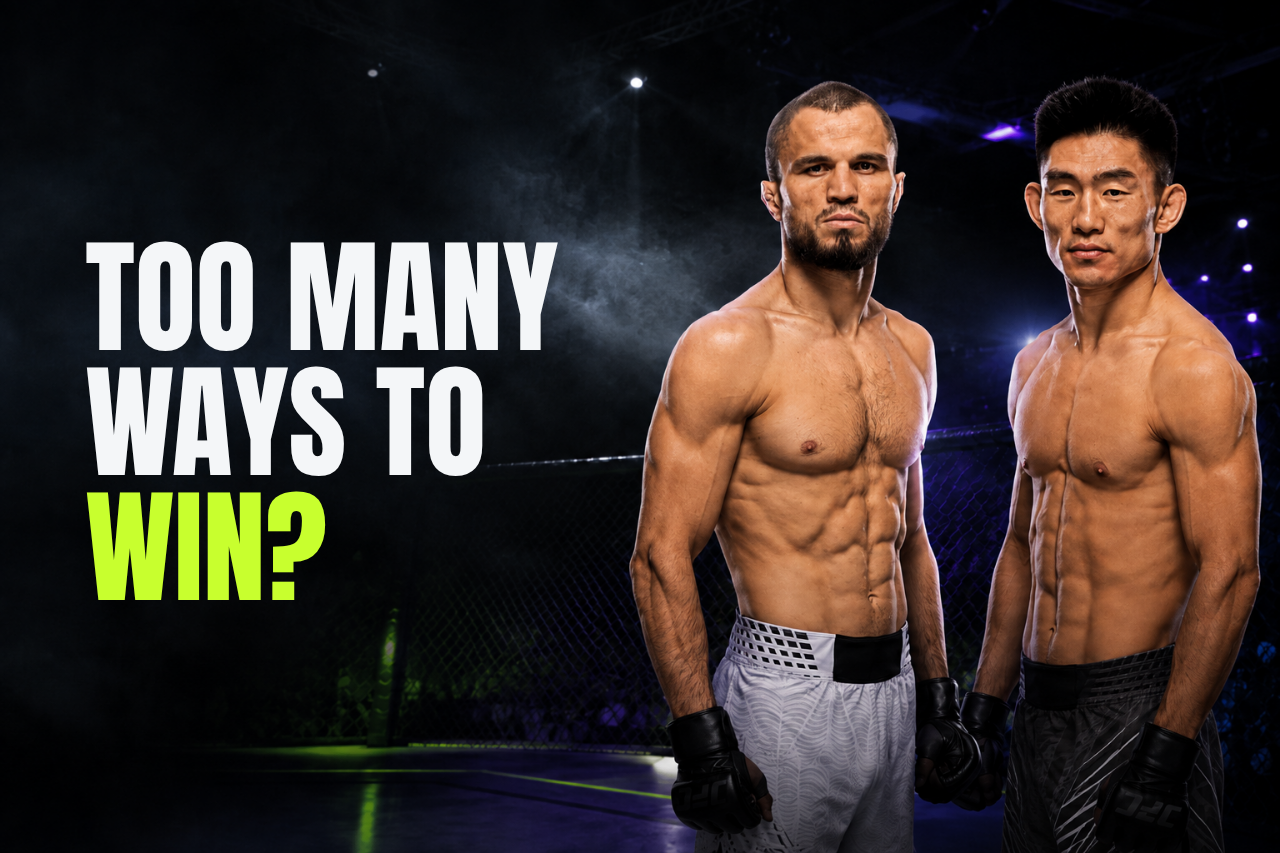
Umar Nurmagomedov vs Song Yadong
The lazy version of this matchup is easy to write. Umar wrestles, Song boxes, and whichever man gets the fight into his preferred phase wins. There is enough truth in that description to make it tempting, but it strips away most of what makes this such an interesting main event.

Nurmagomedov is one of the best wrestlers in the division, but his real advantage is not simply the number of takedowns he lands. It is how much of the fight becomes shaped by the possibility that one is coming. He averages just over four takedowns per 15 minutes, converts them at a strong rate and has built a striking game that benefits enormously from the reactions his wrestling creates. Song lands more significant strikes per minute, but he also absorbs considerably more, while Umar’s defensive numbers remain exceptional for someone who spends so much time forcing opponents into exchanges.
The important question for Song is therefore not whether he can stop a takedown. His career takedown defence is already good enough to tell us that he can. The harder question is whether he can consistently finish the defensive sequence in a position where he can actually attack.
Umar does not need the first shot to work. A failed entry can become a body lock, the body lock can become a trip attempt, the defended trip can turn into cage pressure, and a successful stand-up can simply become another mat return. Song can technically win several moments of that sequence and still spend the best part of a minute doing nothing offensively. That is the hidden cost of fighting someone like Umar. Successful defence only really counts when it ends with separation.
That means Song needs to sprawl, frame, hand-fight and then get off the fence. If he stuffs the shot but Umar still has his hands connected around the waist, the exchange is not over. If he stands up but remains pinned to the cage, the exchange is not over. If he spends 40 seconds successfully defending every individual attempt but finishes the sequence exactly where Umar wants him, Umar has still removed 40 seconds of Song’s best offence from the round.
Song’s own fight is much more dangerous than the simple “puncher” label suggests. He is compact, quick through the middle and technically very good once he can plant his feet and work through combinations. His best performances have shown an ability to build into fights rather than simply hunt one big shot. Against Ricky Simon, for example, he gradually took over the striking exchanges before stopping him late, and his output became cleaner and more efficient as the fight developed.
He has also become a much broader MMA fighter than he was when he first arrived in the UFC. Against Sean O’Malley he landed three takedowns. Against Chris Gutierrez he landed two. He has had to navigate five-round fights, adjust on the fly and survive against some of the smartest bantamweights in the world. His recent submission of Deiveson Figueiredo is relevant too, not because it suddenly makes Song the better grappler in this matchup, but because it reinforces how much more complete he has become.
Umar’s striking is another part of this fight that tends to get understated. His significant-strike accuracy sits well above the divisional norm, his defence is strong and he absorbs very little clean offence. Those numbers are not happening in isolation from the wrestling. They are partly a consequence of it. Opponents have to respect the level change, which changes how aggressively they can step into range. Umar can kick from further away than Song would ideally like to box, switch stance, attack the body and legs, and then use the reaction to those kicks to enter underneath.
The sequence becomes circular. Respect the wrestling and Umar kicks. Pressure the kicks and Umar changes levels. Overreact to the shot and Umar comes back upstairs. Against Figueiredo he comfortably won the striking exchanges while still landing takedowns, which was a useful reminder that this is not a wrestler simply surviving on his feet until he can get back to grappling.
The Mario Bautista fight gave Song something more encouraging to study. Umar had to work hard, attempted an enormous amount of wrestling and was still forced into difficult moments. Bautista even dropped him. Umar is not untouchable, and he can be made to expend energy for his control. Song needs to make those moments more expensive.
His best path is one where the first round contains a lot of wrestling without much actual control. If Song can repeatedly get off the fence, make Umar reset in open space and force him to restart his entries, the striking fight starts to become more important. The body may be a particularly useful target. Umar’s movement and head positioning make him difficult to catch clean upstairs, but the body does not travel as far, and Song has the hand speed to attack underneath the elbows when Umar is trying to retreat from combinations.
If Song can land hard enough early to make every future entry feel less comfortable, the balance of the fight changes. He does not need 25 minutes of clean boxing. He needs enough of it to make Umar think twice about how and when he closes the distance.
The problem is that Umar has far more ways to win minutes. He can score at kicking range, clinch against the fence, land takedowns, force defensive reactions without completing them, and work from top position once he does get the fight down. He can move between those phases without needing one of them to dominate. Song’s route is narrower. He needs to keep dragging the fight back towards the phase where his advantage is clearest.
The current market makes Umar a heavy favourite and our own numbers land in almost exactly the same area, but the method tells a more interesting story. The expectation is not that Umar simply runs through Song. It is that he has enough control over enough phases to win a long fight.
That is where I land too. Song is too experienced, too strong and too technically complete to assume he simply gets drowned, and I expect him to have genuine success, particularly if he can turn several wrestling exchanges into clean resets. Over five rounds, though, Umar’s ability to keep changing the question should become decisive.
The prediction is Umar Nurmagomedov by decision.
Yan Xiaonan vs Denise Gomes
This is probably the most difficult fight on the card to reduce to one clean conclusion because there are two completely defensible versions of the matchup.
One version says Yan Xiaonan is still the better fighter. Her distance management is cleaner, her defensive striking is superior, she has spent years facing a much higher level of opposition and she is far more comfortable winning disciplined rounds without needing to turn the fight into chaos.
The other version asks whether we are analysing the Yan of two or three years ago rather than the woman who will actually walk into the cage on Saturday.

Yan is 37. Gomes is 26. Yan has not fought for 16 months. Gomes is younger, more physical and still adding layers to her game. That gap is impossible to ignore, especially in a division where speed, volume and reaction time are so important.
The raw striking numbers do not separate them much. Yan lands a little more significant volume, Gomes is only slightly behind, and both absorb a similar amount. Yan is considerably cleaner defensively, while Gomes brings more active wrestling and a greater tendency to force physical exchanges.
The strongest argument for Yan is still the version of her we saw against Tabatha Ricci. That was a complete technical dismantling. Ricci barely landed anything early, Yan controlled distance throughout and the fight became progressively more one-sided as she settled into the rhythm. There was nothing especially flashy about it. Yan simply understood the range better, saw the entries sooner and made Ricci pay every time she tried to force her way inside.
That is the kind of fight Gomes cannot afford to give her.
If this becomes a measured kickboxing match where Yan can read the entries, score and exit, the technical gap begins to matter. Yan has spent her career dealing with opponents who punish poor positioning at an elite level. Her recent opposition includes Zhang Weili, Virna Jandiroba, Jessica Andrade, Mackenzie Dern and Ricci. Gomes has been excellent during her rise, but she has not yet lived at that altitude for very long.
The reason this is still uncomfortable is that Gomes is not the same fighter she was a couple of years ago. Her recent performances show more willingness to wrestle, more confidence in physical exchanges and more understanding of how to win rounds when the striking alone is not enough. Against Tecia Pennington she was actually edged in significant strikes, but three takedowns helped change the shape of the fight and gave her another way to score.
That is probably the most relevant development in her game for this matchup. Trying to beat Yan in a clean technical striking contest is unlikely to be the best use of her tools. Gomes needs to make the rounds messy. She needs to pressure, clinch, change levels and force Yan to work physically. Every minute spent hand-fighting, defending takedowns or escaping the fence is a minute where the age gap has a chance to become relevant.
Yan’s last fight against Virna Jandiroba is obviously part of the picture, but I am reluctant to over-transfer that result into this matchup. Yan was not beaten because she suddenly forgot how to strike. She was beaten because Jandiroba imposed an elite positional grappling game, repeatedly got the fight where she wanted it and kept Yan there.
Gomes can wrestle. She is not Jandiroba.
If Gomes does take Yan down, the next question matters just as much. Can she hold her there? Can she create damage? Can she force Yan to burn enough time and energy on the escape that the round genuinely changes? The available evidence does not convince me she can do that consistently against someone with Yan’s experience.
This is also one of the fights where our own data is useful precisely because it disagrees with my instinctive read. The model prefers Gomes, and it is not difficult to understand why. The age gap is enormous, the layoff is significant, Gomes has the better recent trajectory and Yan’s recent losses create plenty of statistical red flags.
I do not think the model is wrong to be worried. I think it may be weighting those warnings more heavily than I am willing to.
The market is much closer, with Yan being a moderate favourite, and that feels more realistic. This should not be treated as a comfortable spot for the veteran. Gomes has a very real route to victory if she can turn the fight into an athletic contest rather than a technical one.
That is the simplest way to describe her path. Make Yan fight at 37. Push her backwards. Force her to defend level changes. Make her separate from clinches. Attack the body. Keep the pace high enough that the layoff and the age have a chance to matter.
Yan’s route is the opposite. She should have no interest in proving she can match Gomes physically. She needs distance, discipline and clean resets. Gomes is the fighter who has to close the gap, and every entry creates another opportunity for Yan to intercept, angle away and score.
I am still taking Yan because I have not seen enough evidence that Gomes can consistently drag her away from that technical striking game. It is one of the lowest-confidence calls among the featured fights, though, and if Yan looks even slightly slower after 16 months away, Gomes has exactly the physical profile to expose it.
The prediction is Yan Xiaonan by decision.
Aoriqileng vs Kai Asakura
Kai Asakura’s UFC career looks much less confusing once you stop treating his first two fights as normal introductions to the promotion.
He arrived from RIZIN and immediately fought Alexandre Pantoja for the flyweight title. Pantoja submitted him. Then Tim Elliott submitted him. Two UFC appearances, two defeats, both at a weight class where Asakura was forcing his body through a cut that had never really looked like the ideal long-term fit.
He moved back to bantamweight in May and knocked Cameron Smotherman out in the first round.
That result did not suddenly transform Asakura into a different fighter. It put him back in the division where he had built most of his reputation in the first place.

Aoriqileng presents a completely different kind of challenge to Pantoja or Elliott, and that is why I think this matchup suits Asakura. Aoriqileng is experienced, aggressive and physically tough, but he also fights in a way that gives opponents a lot of opportunities. He lands plenty of significant strikes, but he absorbs even more, and his defensive numbers are not particularly flattering.
That is a dangerous trade-off against someone with Asakura’s speed.
Asakura is at his best when the opponent gives him predictable opportunities to counter. He does not need much space or much time. He is explosive through the middle, comfortable changing levels with his punches and capable of turning a small mistake into a finishing sequence very quickly.
The question for Aoriqileng is whether he can stop this becoming a clean striking duel.
He does have enough wrestling to make that interesting. He averages more than one takedown per 15 minutes and has shown that he is willing to mix phases when required. Asakura’s UFC takedown-defence sample is hardly reassuring, although it is also almost useless in isolation because the two men testing it were Pantoja and Elliott.
Aoriqileng does not need to become a wrestler for 15 minutes. He just needs to make Asakura think about something other than the striking exchange. If he can crowd the space, force clinches and show an early level change, he can disrupt the rhythm that makes Asakura so dangerous.
What he cannot afford to do is stand at mid-range and turn the fight into a duel.
That plays directly into Asakura’s speed advantage.
The betting market is extremely aggressive about Asakura’s finishing chances, and our winner projection also likes him strongly. The Method model is more conservative and actually sees a decision as slightly more likely than the knockout if Asakura wins.
This is one of the occasions where I am happy to lean away from the model.
A Method model is naturally influenced by historical finishing rates and broader fighter profiles. This matchup is more specific. Aoriqileng’s combination of high absorption, relatively modest defence and willingness to exchange creates exactly the sort of openings Asakura tends to exploit.
Aoriqileng’s best chance is to make the fight physically awkward. Crowd him, push him backwards, force him to work in the clinch and show enough wrestling that Asakura cannot settle into a pure counter-striking rhythm.
Asakura’s route is much cleaner. He does not need to chase the finish. If he stays patient, Aoriqileng’s normal way of fighting should create the opportunities for him.
I do not think this is a prediction that Aoriqileng is easy to put away. It is a prediction that his usual approach creates too many high-quality chances for a striker as explosive as Asakura.
The prediction is Kai Asakura by KO/TKO.
Rei Tsuruya vs Kevin Borjas
Rei Tsuruya’s only professional defeat came against Joshua Van.
That looked like a setback at the time. It looks considerably different now that Van is the UFC flyweight champion.
Tsuruya spent more than a year outside the cage after that loss before returning in May and submitting Luis Gurule in the first round. He is still only 24, still developing and still one of the most interesting grappling prospects in the division.

The numbers make his intentions fairly obvious. Tsuruya averages more than five takedowns per 15 minutes and attempts submissions at an unusually high rate. He is not using wrestling simply as a way to steal rounds or change the pace. His entire offence is organised around forcing contact, creating scrambles and turning one position into the next.
Kevin Borjas is almost the opposite fighter. He wants the fight standing, he has legitimate power and he is far more dangerous when he can work at his preferred distance without having to think constantly about the level change. He also owns respectable takedown defence, which is the one number that gives him a clear route into this fight.
If Borjas can make Tsuruya fail repeatedly in open space, the striking becomes much more interesting. Tsuruya is still developing defensively on the feet, and Borjas has enough power to punish him if the wrestling entries become predictable.
The problem is volume.
Defending one takedown from Tsuruya is not the same as stopping the wrestling. Tsuruya is comfortable continuing through ugly positions. He can move from a shot to a body lock, from a scramble to the back, and from a failed entry to another entry without needing the sequence to look technically perfect.
Against Mark Climaco he landed eight takedowns. Against Joshua Van, four. Against Carlos Hernandez, three. There is persistence built into the style.
Borjas has defended takedowns reasonably well across his UFC sample, but he has not faced many opponents who are likely to ask the question this often.
Their shared history against Joshua Van is interesting too. Borjas lost largely because Van outworked him badly in the striking. Tsuruya also lost a decision to Van, but forced a completely different type of fight through repeated wrestling and grappling exchanges.
That does not mean Tsuruya automatically beats Borjas. MMA maths is never that tidy. What it does show is that Tsuruya has more ways to change the shape of a difficult matchup.
The winner side is straightforward. The market strongly favours Tsuruya and our own projection agrees. The real disagreement comes over how he gets there.
The Method model prefers decision.
The market prefers submission.
I side with the market on that question because the matchup itself creates the conditions for a finish. Repeated takedowns against a fighter who offers almost no offensive grappling threat of his own are more likely to create back exposure, prolonged scrambles and submission opportunities than a broader historical average might suggest.
Borjas’ best path is therefore not merely to defend. He needs to punish every failed entry. He has to hit Tsuruya on the break, attack the body when Tsuruya changes levels and make each future shot come from slightly further away.
If Tsuruya starts hesitating about initiating contact, Borjas gets the sort of fight he wants.
Tsuruya’s route is simpler. He just needs to keep connecting. Once the fight becomes a prolonged grappling exchange, he has more routes through the position than Borjas does.
Borjas should make some of the early entries difficult, and I would not be surprised if the first round contains more resistance than the moneyline suggests. Over time, though, the positional pressure should create opportunities.
The prediction is Rei Tsuruya by submission, with Round 2 the most likely window.
Jack Jenkins vs Sean Woodson
Sean Woodson stands 6ft 2in with a 78-inch reach.
Jack Jenkins is 5ft 7in with a 68-inch reach.
Ten inches is not a piece of trivia in this matchup. It is the problem Jenkins has to solve before almost anything else becomes relevant.

Jenkins is a better striker than those measurements make him sound. He lands well, absorbs relatively little and has built a varied MMA game rather than relying on one route. The problem is that none of those skills can be used effectively if he spends the fight standing exactly where Woodson wants him.
His most obvious weapon is the low kick.
Woodson’s striking benefits enormously from being able to maintain range behind the jab and long straight shots. If Jenkins can damage the lead leg early, he begins to reduce Woodson’s ability to constantly rebuild that distance.
The difficult part is getting close enough to do it without paying for every entry.
Woodson is not simply tall. Plenty of tall fighters have no idea how to use their dimensions. Woodson does. He lands at a high rate, defends well and owns strong takedown defence, which is particularly relevant because wrestling is the most obvious alternative route for Jenkins.
Jenkins averages close to two takedowns per 15 minutes, but his conversion rate in the UFC has been poor. Trying to close a ten-inch reach gap against Woodson is already a difficult task. Trying to do it when the secondary wrestling route is also statistically unreliable makes the problem much worse.
If Jenkins cannot put Woodson against the fence or force him into meaningful grappling exchanges, he may spend long stretches walking through jabs simply to reach the distance where his own offence starts.
The Dan Ige fight does offer some encouragement.
Woodson was winning much of that contest at range before Ige eventually forced his way inside and stopped him. It showed both sides of Woodson at once. The range game worked, until the fight was compressed enough that the physical advantages suddenly mattered far less.
That is the blueprint for Jenkins.
The difference is that Ige did not need to win 15 minutes of that fight.
Jenkins probably does.
His path therefore has to be built around pressure without recklessness. Attack the calf. Attack the body. Force Woodson towards the fence rather than simply following him around the perimeter. Then wrestle when the cage removes some of the space Woodson needs to sprawl and disengage.
Jenkins cannot afford to make every entry about chasing the head. The body and legs are much closer than Woodson’s chin.
If he can damage the stance early and make Woodson less mobile by the second round, the fight starts to become much more manageable.
Woodson’s route is simpler and probably less exciting. Jab, exit, make Jenkins reset, punish the overreach and defend the level change. He does not need to prove he can win a phone-box fight. He needs to make sure one never happens.
The market makes Woodson only a modest favourite. Our own projection is considerably more confident, and this is one of the places where I think the underlying numbers make a strong argument. The reach advantage is enormous, Woodson throws more volume and his takedown defence attacks the most obvious alternative route for Jenkins.
The Method model also leans towards a decision, which fits the likely shape of the fight.
Jenkins is good enough to make this uncomfortable, and his leg attacks could become a genuine problem if Woodson lets him establish them early. The difficulty is that Jenkins has to solve the distance problem repeatedly for 15 minutes, while Woodson only has to keep rebuilding it.
The prediction is Sean Woodson by decision.
One Last Look at Shanghai
The main event deserves its billing because Song Yadong is good enough to make Umar Nurmagomedov answer questions that most bantamweights cannot ask. Song can wrestle, he can defend, he can box at an elite level and he carries enough power to make any lazy entry dangerous. None of that changes the central problem. Umar can win too many different versions of the fight, while Song has to keep dragging it back towards the version that suits him.
Yan Xiaonan against Denise Gomes is far less comfortable. The technical case points towards Yan, but age, inactivity and recent trajectory are pulling hard in the opposite direction. Yan remains the pick because I still trust her ability to manage range and win clean exchanges, but there is very little room for deterioration at 37.
Kai Asakura appears to have finally returned to the division that suits him, and Aoriqileng’s willingness to exchange looks like a dangerous habit against that speed and power. Rei Tsuruya may be the most interesting prospect on the card, particularly now that his only defeat has aged so well, while Jack Jenkins has perhaps the clearest physical problem of any fighter featured here, with ten inches of reach separating him from Sean Woodson before the cage door even closes.
Five fights, five very different problems to solve. That is what makes this Shanghai card worth digging into.
By Saturday night, we will know which answers actually held up.